Education (EdTech)
eLearning and education software development
By Yash Soni, Founder & CEO, Apex36Updated
In short
Apex36 is an education software development team for schools, universities and edtech companies. We build eLearning software, custom LMS features, AI tutors and assessment tools, built for FERPA-regulated student data, COPPA and GDPR. Our edtech work includes a multi-year build of four live products for Basira, from K-12 to higher education. An MVP starts from $5,000.
Key facts
| Starting price | MVP from $5,000; AI features from $8,000 |
|---|---|
| Typical first milestone | Discovery typically in under a week; first shippable milestone typically in 1 to 3 weeks |
| Engagement model | Fixed-scope MVP, then a monthly team as you grow |
| Markets | US, UK, Australia, Singapore, UAE |
| Built for | FERPA-regulated student data (US), COPPA for users under 13, GDPR |
Education software development for schools, universities and edtech
Education software has more users with different rights than most products: students, teachers, parents, school admins and sometimes a district or a university office above them. Getting roles and data boundaries right is most of the work. For Basira we built four education products over a multi-year engagement, all four now live: GyaanSchool for K-12, Qoollege for higher education, PiSolved for AI-assisted problem solving, and Sequent, an LLM RAG platform for one of Basira's enterprise clients. Each had a different stack, from .NET and Angular to Next.js and Python.
eLearning software development, from MVP to multi-product platform
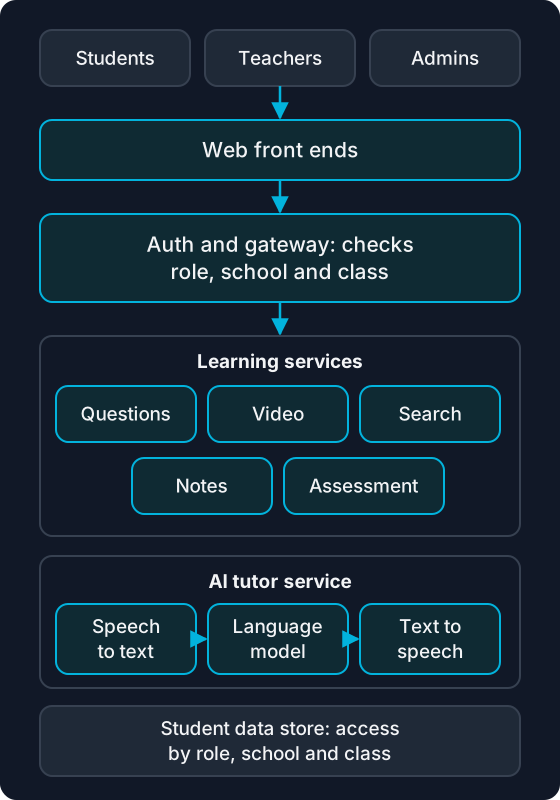
Most eLearning platforms start as one course flow and grow into many services. We plan for that growth without building it on day one. A first version covers sign-in, roles, content and one learning loop. Later, the pieces that grow fastest, such as questions, video, search and notes, become their own services. GyaanSchool runs that way: a .NET GraphQL core, Node.js services for authentication, questions, search, videos, notes and background work, and Angular front ends, shipped through Azure DevOps pipelines. Qoollege runs on Next.js on its own Kubernetes cluster, with a pipeline that gathers university data into the platform.
Custom LMS development: when to build and when to extend
A learning management system (LMS) handles courses, enrolments, assignments, grades and reports. For standard courses, an existing LMS such as Moodle or Canvas is often enough, and we will say so. Custom LMS development makes sense when your teaching model does not fit: speaking practice, adaptive question banks, a marketplace of tutors, or reporting your schools actually ask for. A middle path is common too: keep the LMS for enrolment and grades, and build the custom learning experience beside it, connected through its API or the LTI standard.
AI tutors and speaking practice
AI tutoring works when the tutor responds fast enough to feel like a conversation. For Lang AI Tutor, we built AI-avatar language tutors on a realtime pipeline: speech to text, a language model, then text to speech, at conversational latency, with a video avatar so learners talk to a consistent persona instead of a chat box. The tutor keeps context across turns, so it can refer back to what the learner said and adjust the practice.
We are also building our own AI speaking tutor for schools, at proof-of-concept stage: a teacher assigns a timed speaking session, the student practises with an avatar, and both see a formative score for fluency, accuracy and vocabulary. It stores the assessment only, not raw audio or video.
Assessment and screening tools
Assessment software must support professional judgement, not replace it. For Noetic we built a screening platform covering ADHD, autism, dyslexia, dyspraxia and dyscalculia, with a structured intake and reports that help clinicians and learning-support staff make the final call. When we add AI to assessment, it produces formative feedback with the reasoning shown, and a teacher or specialist owns the grade.
Built for FERPA-regulated data, COPPA and GDPR
Student data carries legal duties that differ by country and by age. We build to the controls your school, district or university sets:
- Access limited by role, school and class, so a teacher sees only their own students
- Data minimisation: collect what the learning flow needs and nothing more
- Parental consent flows and restricted features for users under 13, where COPPA applies
- EU or UK hosting for GDPR, and deletion on request
- Logs of who viewed or changed student records
Sign-off stays with your institution. We document how each control is met so your data protection lead can review it.
EdTech software development for startups
EdTech founders need to prove that schools will use and pay for the product before they build everything. We build an MVP from $5,000: one learning flow, accounts and roles, and a deployment you own. When the product works, we stay on as a monthly team and set up the infrastructure to scale it, from CI/CD pipelines to Kubernetes (see DevOps and cloud).
What education software costs
An eLearning MVP starts from $5,000 for one core learning flow with accounts, roles and a deployment you own. AI tutoring, speech, LMS integrations and multi-school reporting add to that, and AI features start from $8,000. Model and cloud costs are billed to your own accounts. You get a fixed quote in writing after a short discovery. See pricing.
Proof from our work
EdTech · Multi-Product
Basira
Four education products for one client over a multi-year build: GyaanSchool (K-12), Qoollege (higher education), PiSolved (AI problem solving) and Sequent (an LLM RAG platform for Basira's enterprise client). All four are live.
Read the case studyEdTech · Voice AI
Lang AI Tutor
AI-avatar language tutors on a realtime speech pipeline. The client's result: 10+ UK schools subscribed in the first 3 months, with no outside funding.
Read the case studyEdTech · Assessment
Noetic
A screening platform for ADHD, autism, dyslexia, dyspraxia and dyscalculia, with structured intake and reporting for clinicians.
Read the case study
Frequently asked questions
At Apex36, an eLearning MVP starts from $5,000 for one learning flow with accounts, roles and a deployment you own. AI tutoring, LMS integrations and multi-school reporting add to the price. You get a fixed quote in writing after a short discovery.
Use an existing LMS when your courses are standard. Build custom when your teaching model, data or reporting does not fit, or keep the LMS for enrolment and grades and build the learning experience beside it, connected through its API or LTI.
An LMS manages courses, enrolments, assignments and grades. An eLearning platform is the wider product learners use, which can include an LMS plus content, practice, AI tutoring, video and search.
Yes. We add AI tutoring as a service your platform calls, with speech, a language model and text to speech where speaking practice is needed. We test it on your own learners' examples before launch.
Yes. We build for FERPA-regulated student data, COPPA for users under 13 and GDPR, with role-based access, data minimisation, consent flows and access logs. Sign-off stays with your institution; we document how each control is met.
Discovery typically takes under a week, and the first shippable milestone typically lands in 1 to 3 weeks. A full MVP depends on scope; you see a demo and a written changelog every week.
Yes. For Basira we built GyaanSchool for K-12 and Qoollege for higher education, plus an AI problem-solving product and an LLM RAG platform.
Services for this industry: SaaS and MVP development · AI consulting and development · DevOps and cloud consulting
Find out what to build first
Start with the free AI readiness assessment and get a written report by email, or book a 30-minute strategy call with the founder.