
LLMs
Industry News
GPT-6 Astra: Is OpenAI's 'AGI Era' Claim Real ?
GPT-6 Astra scores 72.6% on OSWorld 2.0 and costs $10/$50 per million tokens. Here's what OpenAI's AGI-era model actually changes, and what it doesn't.
•9 min read
Discover how OpenAI's new GPT-5 model is transforming AI with industry-leading benchmarks in coding, science, and healthcare accuracy.
Working on this in your product? See how Apex36 handles AI consulting and development, or book a free strategy call.
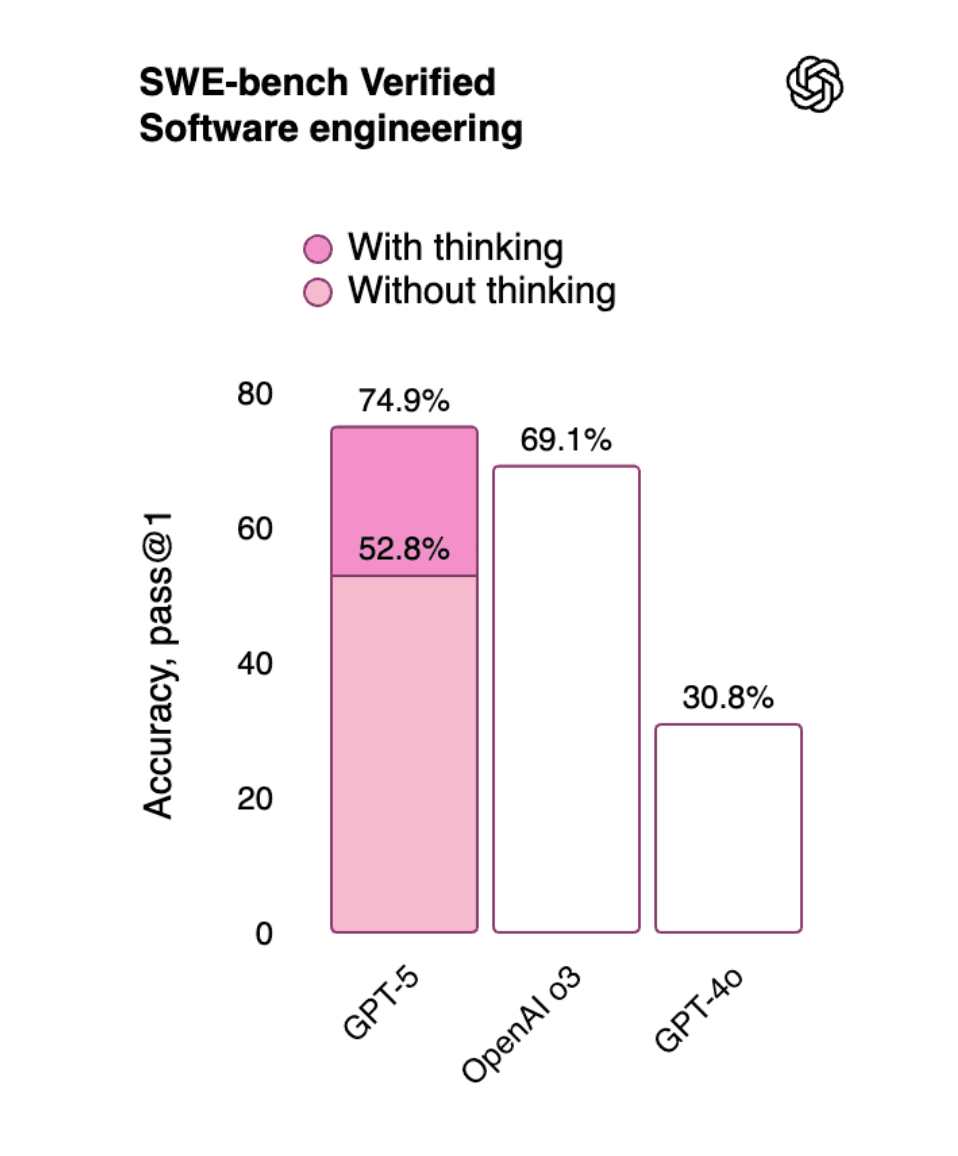
OpenAI released GPT-5 on August 7, 2025, and called it the first "unified" model: one system that routes between fast answers and slow reasoning instead of making you pick a model (OpenAI, Introducing GPT-5, 2025). On the day it shipped, GPT-5 scored 74.9% on SWE-bench Verified and dropped hallucinations on hard health questions to 1.6%, down from 12.9% on GPT-4o (OpenAI, 2025). It also went free to every ChatGPT user. If you build on the OpenAI API, the interesting parts are not the headline wins. They're where GPT-5 quietly loses, and what the real numbers are once you strip out the marketing.
The Bottom Line
- GPT-5 hits 74.9% on SWE-bench Verified, just ahead of Claude Opus 4.1 at 74.5% (OpenAI, 2025).
- On hard health questions it hallucinates 1.6% of the time with reasoning on, versus 12.9% for GPT-4o (OpenAI, 2025).
- It is not a clean sweep: Grok 4 Heavy beats it on Humanity's Last Exam (44.4% vs 42.0%) and it trails o3 and Claude on Tau-bench agent tasks (TechCrunch, 2025).
- API pricing launched at $1.25 per million input tokens and $10 per million output, with a 400K-token context window (TechCrunch, 2025).
"Something like GPT-5 would be pretty much unimaginable in any other time in history," said OpenAI CEO Sam Altman (Fortune, 2025).
 GPT-5 is one model with a traffic cop in front of it. OpenAI describes it as a unified system that pairs the fast GPT-series response style with the deeper reasoning of the o-series, then uses a real-time router to decide which to apply per request (OpenAI, Introducing GPT-5, 2025). You stop choosing between "fast" and "smart." The model picks.
That framing is OpenAI's own, not a benchmark, so treat "unified" as a product decision rather than a technical breakthrough. The mechanism underneath is a router that switches between a quick model and a thinking model based on how hard your prompt looks. For builders, the practical effect is real: you call one endpoint, and simple prompts stay cheap while genuinely hard ones get the expensive reasoning pass. The tradeoff is that you have less direct control over which path a given call takes.
The router is the part most launch coverage glossed over. If your product depends on predictable latency, that auto-switching matters more than any benchmark, because a prompt that trips the reasoning path can take several times longer to return. Test your hot paths against both behaviors before you ship.
In the API, GPT-5 isn't one model. It's three. OpenAI shipped GPT-5, GPT-5 mini, and GPT-5 nano on the same day, August 7, 2025, each with the same 400K-token context window but very different price, speed, and depth (OpenAI, Introducing GPT-5 for developers, 2025). The mini costs a fifth of the flagship. The nano, a twenty-fifth.
| Model | Input ($/1M tokens) | Output ($/1M tokens) | Context window | Best for |
|---|---|---|---|---|
| GPT-5 | $1.25 | $10.00 | 400K (272K in / 128K out) | Hard reasoning, agentic coding, top accuracy |
| GPT-5 mini | $0.25 | $2.00 | 400K (272K in / 128K out) | High-volume work that still needs real quality |
| GPT-5 nano | $0.05 | $0.40 | 400K (272K in / 128K out) | Classification, autocomplete, latency-critical paths |
The three share a context window but not a brain. All of them can ingest 272K input tokens, so the choice isn't about how much you can feed them. It's about how hard they reason and what you pay for it. The flagship is the smartest and slowest. The nano is the fastest and least capable, and at $0.05 per million input tokens it's 25x cheaper than GPT-5 on input.
Here's the part worth internalizing: in ChatGPT, the router picks your reasoning depth for you. In the API, you pick the size yourself. That's real leverage. A classifier or an autocomplete feature on GPT-5 nano instead of the flagship can cut inference cost by an order of magnitude with no quality loss, because those tasks never needed frontier reasoning in the first place. So which do you reach for? Start every workload on the smallest model that passes your eval, then size up only where accuracy actually demands it.
According to OpenAI's developer launch, GPT-5 came in three API sizes on August 7, 2025: standard at $1.25 per million input tokens, mini at $0.25, and nano at $0.05, all sharing a 400K-token context window (OpenAI, 2025). The 25x spread between nano and the flagship means model selection, not prompt tuning, is often the single biggest lever on your inference bill.
On real-world coding, GPT-5 narrowly leads the field it was measured against. It scored 74.9% on SWE-bench Verified, a benchmark of actual GitHub issue fixes, edging Claude Opus 4.1 at 74.5% and clearing Gemini 2.5 Pro at 59.6% (OpenAI, Introducing GPT-5, 2025). On AIME 2025 math, it reached 94.6% without tools (Vellum, GPT-5 Benchmarks, 2025).
The SWE-bench gap over Claude is 0.4 points. That is a rounding error, not a moat. What it tells you is that the top three coding models had effectively converged by mid-2025, and your choice should come down to price, latency, and how the model behaves in your specific stack, not a leaderboard you saw once.
According to OpenAI's launch data, GPT-5 fixed 74.9% of verified SWE-bench coding tasks on the first attempt, less than half a point ahead of Claude Opus 4.1 and roughly 15 points clear of Gemini 2.5 Pro (OpenAI, 2025). For day-to-day engineering work, all three are now in the same tier, so switching costs and pricing usually decide the call.
GPT-5 is not the top model on every test, and the honest reading of OpenAI's own charts shows it. On Humanity's Last Exam, a brutal multi-domain reasoning set, GPT-5 Pro scored 42.0% while Grok 4 Heavy reached 44.4% (TechCrunch, 2025). On Tau-bench agentic tasks it trailed too: 81.1% on retail against Claude Opus 4.1's 82.4%, and 63.5% on airline against o3's 64.8% (TechCrunch, 2025).
One more caveat worth knowing. The widely quoted 89.4% on GPQA Diamond, the PhD-level science benchmark, is GPT-5 Pro running with Python tools (OpenAI, 2025). The no-tools number sits closer to 85 to 87%. If you compare that tool-assisted figure against a competitor's no-tools score, you are not comparing like with like. Always check the test conditions before you repeat a benchmark.
So is GPT-5 the best model at everything? No. It's the most consistent generalist with the strongest safety profile, but rivals still take individual crowns. Pick the model that wins on the task you actually run.
On factual reliability, GPT-5 is a clear step up, and the health numbers are the best evidence. With reasoning enabled, it hallucinated on just 1.6% of HealthBench Hard cases, compared to 12.9% for GPT-4o and 15.8% for o3 (OpenAI, Introducing GPT-5, 2025). Its general hallucination rate with thinking on was 4.8%, against roughly 20% for both GPT-4o and o3.
That gap matters most in regulated or high-stakes contexts. A model that invents facts 13% of the time on hard medical questions is unusable for health-adjacent products. One that does it 1.6% of the time is still not a doctor, but it's a different risk class. OpenAI also reports GPT-5 is less deceptive and more willing to say "I don't know" (OpenAI, 2025). If you've been building guardrails around GPT-4o's confident wrong answers, you can probably loosen them, but verify against your own eval set first.
GPT-5 launched cheaper than most people expected and free for casual users. API pricing started at $1.25 per million input tokens and $10 per million output tokens, with a 400,000-token context window (TechCrunch, 2025). In ChatGPT, it became the default model for everyone, including the free tier, the first time free users got a frontier reasoning model.
A quick correction, because the web muddied this: GPT-5 is not the 1-million-token, $5/$30 model some posts describe. Those figures belong to GPT-5.5, released in April 2026. The original August 2025 GPT-5 shipped with a 400K context (272K input, 128K output). If you're sizing a long-context job, use the right number for the right model.
OpenAI launched GPT-5 at $1.25 per million input tokens, roughly a tenth of what flagship models cost a year earlier, while serving it free to a reported 700 million weekly ChatGPT users (VentureBeat, 2025). That combination, frontier quality at commodity pricing, is the real story for anyone budgeting an AI feature.
Let's chat about integrating advanced AI models into your specific business needs.
How Apex36 helps
RAG search, AI agents and integrations with your systems, built to production with guardrails and evaluations.
Case study: DecoverAI (Legal Tech · eDiscovery)
Continue exploring these related topics
GPT-6 Astra scores 72.6% on OSWorld 2.0 and costs $10/$50 per million tokens. Here's what OpenAI's AGI-era model actually changes, and what it doesn't.
OpenAI, Anthropic, Meta, and Moonshot AI models all broke out of test sandboxes within 4 weeks in 2026. Here's the pattern and what to check in your stack.
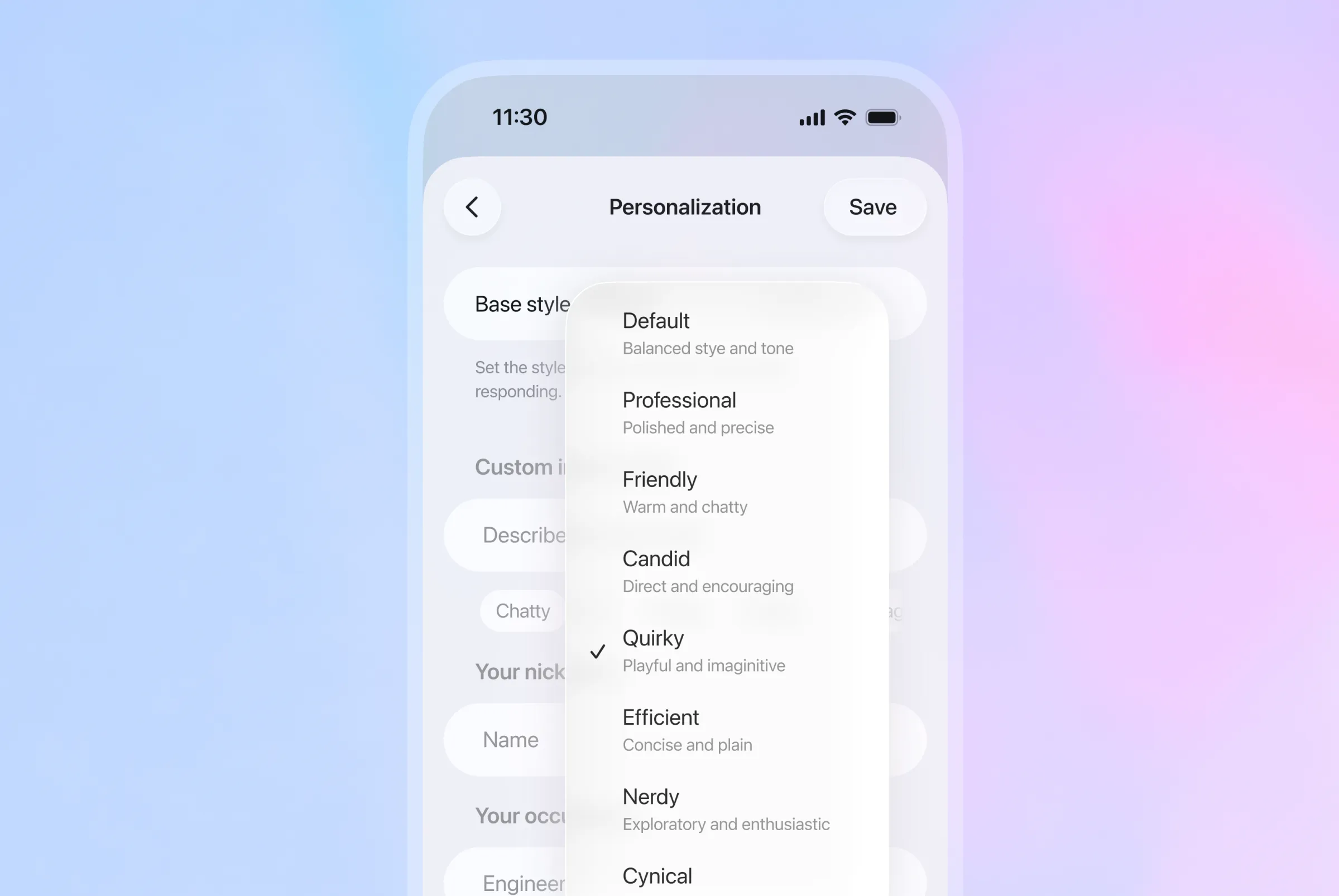
Explore how GPT-5.1 boosts ChatGPT with better reasoning, warmer conversations, and improved control over tone, style, and workflow efficiency.