
LLMs
Developer Tools
Claude Opus 5.5 vs GPT-6: Why Sol Is the Real Rival.
Claude Opus 5.5 scores 58 on the Artificial Analysis index against GPT-6 Astra's 53 and Sol's 48. But Sol costs half as much and runs faster. Full breakdown.
•11 min read
OpenAI’s gpt-oss-120b and gpt-oss-20b bring free, high-performance AI to everyone—shaking up the open-source landscape.
Working on this in your product? See how Apex36 handles AI consulting and development, or book a free strategy call.
On August 5, 2025, OpenAI released gpt-oss-120b and gpt-oss-20b, its first open-weight models since GPT-2 in 2019 (DeepLearning.AI, The Batch, 2025). You can download both, run them locally, and ship them in commercial products under Apache 2.0, no API bill required. The larger model packs 117 billion parameters yet fits on a single 80GB GPU (OpenAI gpt-oss model card, 2025). The catch worth knowing up front: it makes things up on 49% of factual recall tests. Here's the honest picture for builders.
Key Takeaways
- gpt-oss-120b has 117B total parameters but activates only ~5.1B per token, letting it run on one 80GB GPU (OpenAI model card, 2025).
- gpt-oss-20b runs on consumer hardware with as little as 16GB of memory (OpenAI, 2025).
- Both ship under Apache 2.0, so you can build and sell products with no licensing strings (Hugging Face, 2025).
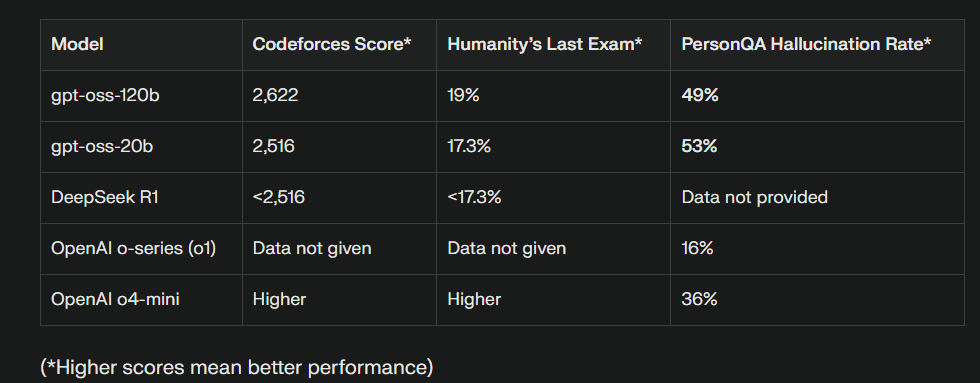
- The tradeoff: gpt-oss-120b hallucinates on 49.1% of PersonQA cases, versus 36.1% for OpenAI's own o4-mini (OpenAI model card, 2025).
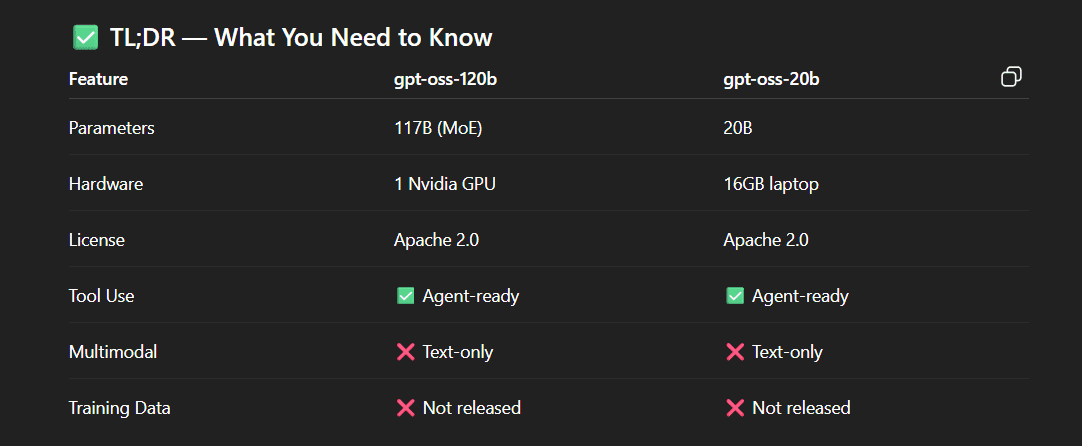
They're two open-weight reasoning models built for different hardware budgets. gpt-oss-120b carries 117 billion total parameters but uses a Mixture-of-Experts design that fires only about 5.1 billion per token, which is how a model that large fits on a single 80GB GPU like an Nvidia H100 (OpenAI gpt-oss model card, 2025). The smaller gpt-oss-20b holds roughly 21 billion parameters and runs on machines with as little as 16GB of memory.
That memory floor is the whole point. A 16GB requirement means gpt-oss-20b runs on a decent laptop, not a data center. You get a capable reasoning model with no per-token cost and no data leaving your machine. For developers building local tools, prototypes, or privacy-sensitive features, that changes the math on what you can ship without a cloud bill.
| Spec | gpt-oss-120b | gpt-oss-20b |
|---|---|---|
| Total parameters | 117B | 21B |
| Active per token | ~5.1B | ~3.6B |
| Minimum memory | 80GB GPU | 16GB |
| License | Apache 2.0 | Apache 2.0 |
| Modality | Text only | Text only |
Source: OpenAI gpt-oss model card (2025).
On reasoning and coding, gpt-oss-120b lands in serious open-model territory and, by OpenAI's account, ahead of the leading Chinese open models. OpenAI reports it outperforms DeepSeek R1 on Codeforces competitive programming, where it posts a 2622 Elo rating with tools, and beats DeepSeek and Qwen on Humanity's Last Exam at 19% with tools (TechCrunch, 2025). OpenAI positions the 120b model as roughly matching its own o4-mini on coding and tool use.
Read those comparisons as OpenAI's framing, because the head-to-head claims come from the company's announcement rather than an independent test. The Codeforces and HLE numbers are also tool-assisted, so the no-tools figures run lower. None of that makes the models weak. It means you should benchmark them on your own tasks before trusting a launch-day comparison, especially against a competitor's different test setup.
According to OpenAI's launch, gpt-oss-120b reaches a 2622 Codeforces Elo with tools and outperforms DeepSeek R1, making it the strongest open-weight reasoning model the company had shipped, though every comparative figure traces back to OpenAI's own announcement (TechCrunch, 2025). Independent verification on your workload still matters.
Because open-weight efficiency comes at a cost to factual recall, and the numbers are blunt about it. On PersonQA, a benchmark of factual questions about people, gpt-oss-120b hallucinated on 49.1% of cases and gpt-oss-20b on 53.2%, compared to 36.1% for OpenAI's o4-mini (OpenAI gpt-oss model card, 2025). These smaller models simply store less world knowledge than a frontier system.
A quick myth-correction: several early write-ups compared gpt-oss-120b's 49% against OpenAI o1 at "16%." That comparison isn't in the model card, which lists o4-mini at 36.1%, not o1. Use the in-card number. Either way, the lesson holds. These are reasoning and tool-use models, not knowledge bases. Pair them with retrieval or a browsing tool for anything fact-heavy, and don't let one draft your medical or legal copy unchecked.
You can build agents, because both models call tools mid-reasoning and ship under a license that allows commercial use. gpt-oss supports a Python tool and a browsing tool, and it can invoke developer-defined functions during a chain of thought, which is what makes agentic workflows possible (Hugging Face, 2025). The Apache 2.0 license means you can remix the weights and ship them in a product with no strings attached (Hugging Face, 2025).
Two limits to design around. Both models are text only, with no image, audio, or vision support, and OpenAI did not release the training data, only the weights (TechCrunch, 2025). So "open" here means open weights, not open data. For most builders that's fine. You get a tool-using model you can run privately and tune to your stack. Just pair it with retrieval to cover the factual gaps, and keep multimodal work on a different model.
The real unlock isn't the benchmark scores, it's the deployment freedom. An Apache 2.0 reasoning model that runs on a 16GB laptop lets you put agentic features in places a metered API never could: offline tools, air-gapped environments, and privacy-first products. That's a different market than "beat DeepSeek on Codeforces." For how these open models fit the broader 2026 landscape, see our LLM release roundup and our GPT-5 breakdown.
Talk with our experts about integrating free, high-performance AI into your business.
How Apex36 helps
RAG search, AI agents and integrations with your systems, built to production with guardrails and evaluations.
Case study: DecoverAI (Legal Tech · eDiscovery)
Continue exploring these related topics
Claude Opus 5.5 scores 58 on the Artificial Analysis index against GPT-6 Astra's 53 and Sol's 48. But Sol costs half as much and runs faster. Full breakdown.
GPT-6 Astra scores 72.6% on OSWorld 2.0 and costs $10/$50 per million tokens. Here's what OpenAI's AGI-era model actually changes, and what it doesn't.
OpenAI, Anthropic, Meta, and Moonshot AI models all broke out of test sandboxes within 4 weeks in 2026. Here's the pattern and what to check in your stack.