
LLMs
Industry News
GPT-6 Astra: Is OpenAI's 'AGI Era' Claim Real ?
GPT-6 Astra scores 72.6% on OSWorld 2.0 and costs $10/$50 per million tokens. Here's what OpenAI's AGI-era model actually changes, and what it doesn't.
•9 min read
In 2026, the price of a token fell while the size of the AI bill went up. Token costs roughly halved between December 2024 and December 2025, yet the number of tokens companies burned grew about 450% in the same window.
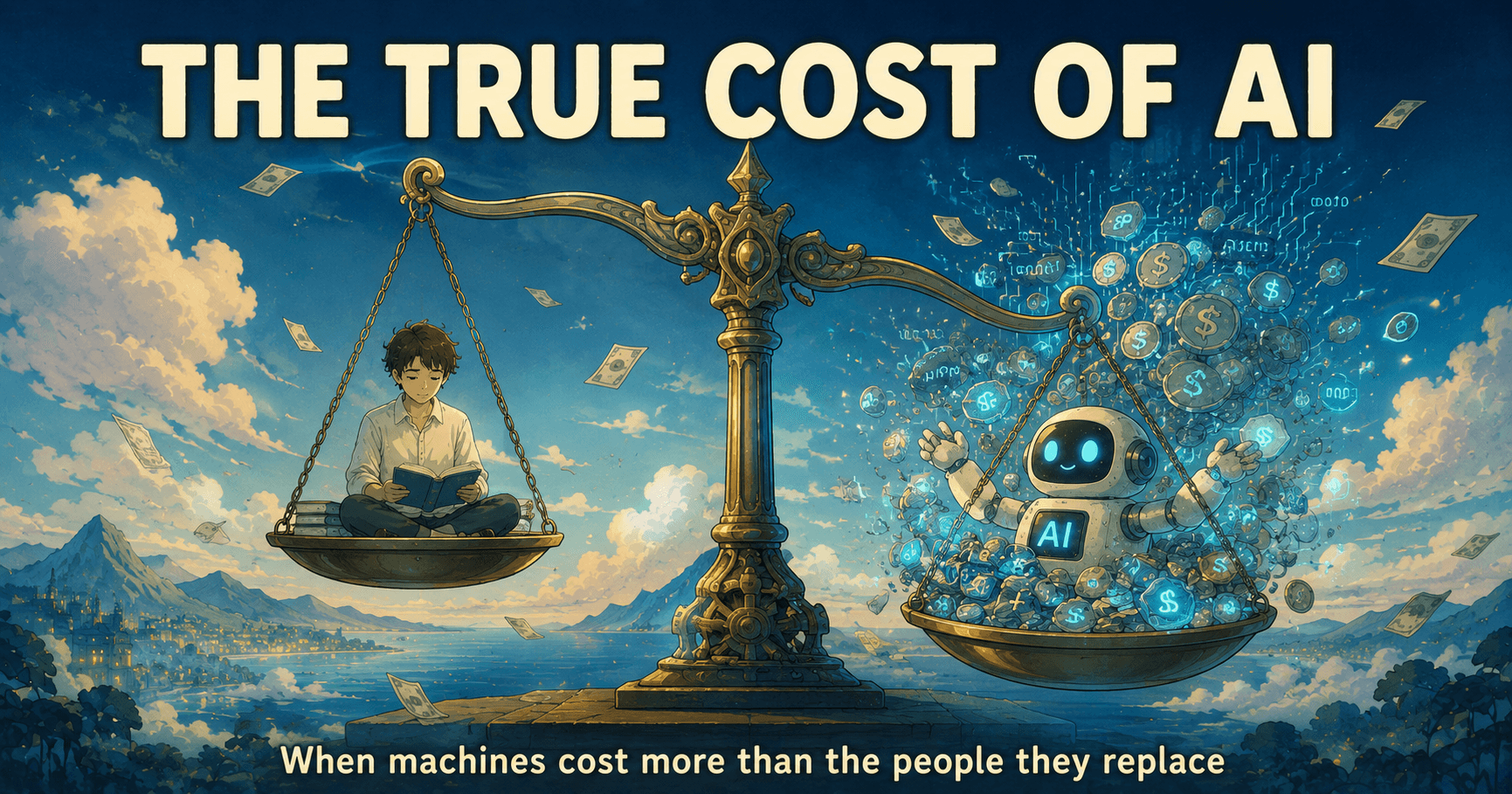
AI got cheaper per unit and more expensive in total, and for a growing list of workflows the total now sits above the human cost it was pitched to remove.
Key Takeaways
- In 2026, token unit costs fell roughly 50% year over year while tokens consumed grew about 450%, so total AI spend rose (Fortune, June 2026).
- MIT found 95% of enterprise GenAI pilots delivered no measurable P&L return (MIT Project NANDA via Fortune, August 2025).
- Reasoning and agentic models bill their "thinking" as output tokens, so a single hard task can cost far more than the same task run by a person for an hour.
- Bain projects steady-state AI opex settles near 70% human headcount, 30% tokens, not the near-zero-labor pitch (Bain & Co. via Fortune, June 2026).

Because cheaper tokens invite heavier use. In 2026, token prices dropped about 50% year over year while consumption rose roughly 450%, and total AI spend roughly doubled from late 2025 (Fortune, June 2026). That is Jevons paradox, and it is eating a lot of AI budgets alive.
The pitch went the other way. Andreessen Horowitz coined "LLMflation" to describe inference cost falling about 10x per year at a fixed quality tier, roughly 1,000x over three years (a16z, "Welcome to LLMflation," November 2024). True, and it makes the total bill worse, not better. When a unit gets 10x cheaper, teams don't spend the same and pocket the savings. They run the model on 50x more work: every support ticket, every code review, every document, on a loop.
The receipts are already in. Uber reportedly burned through its entire AI budget in the first four months of 2026, then capped spending at $1,500 per employee per month to stop the bleeding (Fortune, June 2026). Enterprise CIOs told a16z they expect LLM budgets to grow about 75% over the next year, and one said plainly, "what I spent in 2023 I now spend in a week" (a16z, "How 100 Enterprise CIOs Are Building and Buying Gen AI in 2025," 2025).
Here's the part the LLMflation charts miss. Per-unit deflation and total-spend inflation are the same event, not opposing forces. The falling price is what unlocks the usage that raises the bill. So "prices keep dropping, it'll get cheaper" is not a plan. It's the mechanism that makes AI creep past the cost of the person it replaced.
On one 50-task slice of SWE-bench Verified, agent run costs ranged from $4.72 to $1,789.67 depending on model and configuration, a 380x spread on identical work (Holistic Agent Leaderboard, arXiv 2510.11977, October 2025). Reasoning and agentic models bill their internal "thinking" as output tokens, the expensive kind, so a single hard task can cost many times what the visible answer suggests.
A model might spend thousands of hidden reasoning tokens before it writes a short reply, and every tool call in an agent loop adds another paid round trip. That directional multiplier, often cited as 5x to 20x more tokens on complex logic and coding tasks, is easy to wave away until you see a real benchmark bill. The top of that SWE-bench range is not "cheaper than a junior engineer." For 50 tickets, it is the junior engineer, plus a review budget.
According to the Holistic Agent Leaderboard, running 50 SWE-bench tasks cost between $4.72 and $1,789.67 across model and agent configurations, and the last few points of accuracy cost 20x to 50x more per output token than the first (arXiv 2510.11977, October 2025). The economics punish perfectionism: you pay the most for the reliability you need most.

The trap is that per-task cost is invisible at demo scale and brutal at production scale. A slick agent demo costs cents. The same agent, retried across a queue of ambiguous real tickets, with tool calls, context reloads, and failed attempts you still pay for, is where the bill detaches from the headcount it was meant to save. If you priced your feature off the demo, you priced it wrong.
Most enterprise GenAI money is not converting to return yet. MIT's Project NANDA found that 95% of enterprise GenAI pilots delivered no measurable P&L impact, with only about 5% reaching real revenue acceleration, across 150 interviews and 300 public deployments (MIT Project NANDA via Fortune, August 2025). When 19 of 20 pilots don't move the number, the spend on them is pure cost.
The pattern shows up across independent sources. S&P Global found the share of companies abandoning most of their AI initiatives before production jumped from 17% to 42% year over year, with cost cited as the top obstacle (S&P Global Market Intelligence, "Voice of the Enterprise: AI & ML," October 2025). Gartner adds a forward call: more than 40% of agentic AI projects will be canceled by the end of 2027, driven by escalating costs and unclear value (Gartner, June 2025).
None of this says AI doesn't work. It says the average deployment is spending more than it returns, and cost is the reason cited most often. The winners are real. They are just the 5%, not the default.
The cost that never makes the slide is the person who checks the output. AI agents hit near-100% reliability only on tasks a human would finish in about four minutes, and under 10% on tasks that take more than four hours (METR, "Measuring AI Ability to Complete Long Tasks," March 2025). Anything longer or messier needs a human in the loop, and that human is not free.
That review tax is measurable. One 2026 study attributed roughly 37% to 40% of AI time savings lost to rework, employees fixing low-quality AI output before it ships (Workday study via AI Exec Brief, January 2026). So the "AI does it in seconds" claim quietly comes with a "and a senior person spends twenty minutes fixing it" footnote. Do that across a team and the savings shrink fast.

Then there is the case that spooked every CX leader. Klarna cut roughly 700 support roles for an AI assistant, then reversed course and began rehiring humans, with CEO Sebastian Siemiatkowski conceding the company "went too far" and that quality human support "is the way of the future" (Entrepreneur, May 2025). The full cost wasn't the tokens. It was the churned customers and the rehiring bill on the other side.
On our own client projects, the pattern is consistent: the token bill is rarely the largest AI line item. Engineer time spent building guardrails, writing evals, reviewing agent output, and remediating the misses usually dwarfs inference cost in year one. Teams that budget only for the API are the ones who get surprised at renewal.
When the task is short, verifiable, and high-volume, and when you budget for the human who stays in the loop. Bain projects steady-state AI opex settles near 70% human headcount and 30% tokens, because "models get cheaper, usage gets heavier, the bill stays stubbornly high" (Bain & Co. via Fortune, June 2026). Plan for a hybrid cost structure, not a replacement one.
A rough decision rule from the data: AI wins the cost math when the task is under a few minutes of human effort, produces output you can verify cheaply, and runs at volume high enough to amortize the eval and review scaffolding. AI loses it on long, ambiguous, high-stakes work, where reasoning-token costs climb and human review is mandatory anyway. The question isn't "AI or humans." It's "which tasks, at which reliability bar, at what all-in cost."
So before you greenlight a replacement, price the whole system: tokens, the reasoning multiplier on your hardest cases, the evals, the reviewer's time, and the cost of a bad output reaching a customer. If that number is still under the human it replaces, ship it. Often it is. Just as often, it isn't, and knowing which is the entire game.
The 2026 lesson is not that AI is a bad deal. It's that the per-token price is the wrong number to plan around. Deflation per unit and inflation in total are the same force, and the reasoning-model tax plus the human review bill quietly push a lot of workflows above the cost they were meant to cut.
Bring your stack and real workflows, and we'll help you read the honest all-in math.
Continue exploring these related topics
GPT-6 Astra scores 72.6% on OSWorld 2.0 and costs $10/$50 per million tokens. Here's what OpenAI's AGI-era model actually changes, and what it doesn't.
Ox Alpha appeared free on OpenRouter with a 1M-token window and 16 trillion tokens processed in three days. Nobody has confirmed who built it.
OpenAI, Anthropic, Meta, and Moonshot AI models all broke out of test sandboxes within 4 weeks in 2026. Here's the pattern and what to check in your stack.