
LLMs
AI Models
What Is Ox Alpha? Inside AI's Newest Stealth Model
Ox Alpha appeared free on OpenRouter with a 1M-token window and 16 trillion tokens processed in three days. Nobody has confirmed who built it.
•7 min read
GLM-5.2 is Z.ai's new flagship text model for long-horizon engineering work: 1M-token context, 128K maximum output, function calling, structured output, MCP integration, and a public model card on Hugging Face.
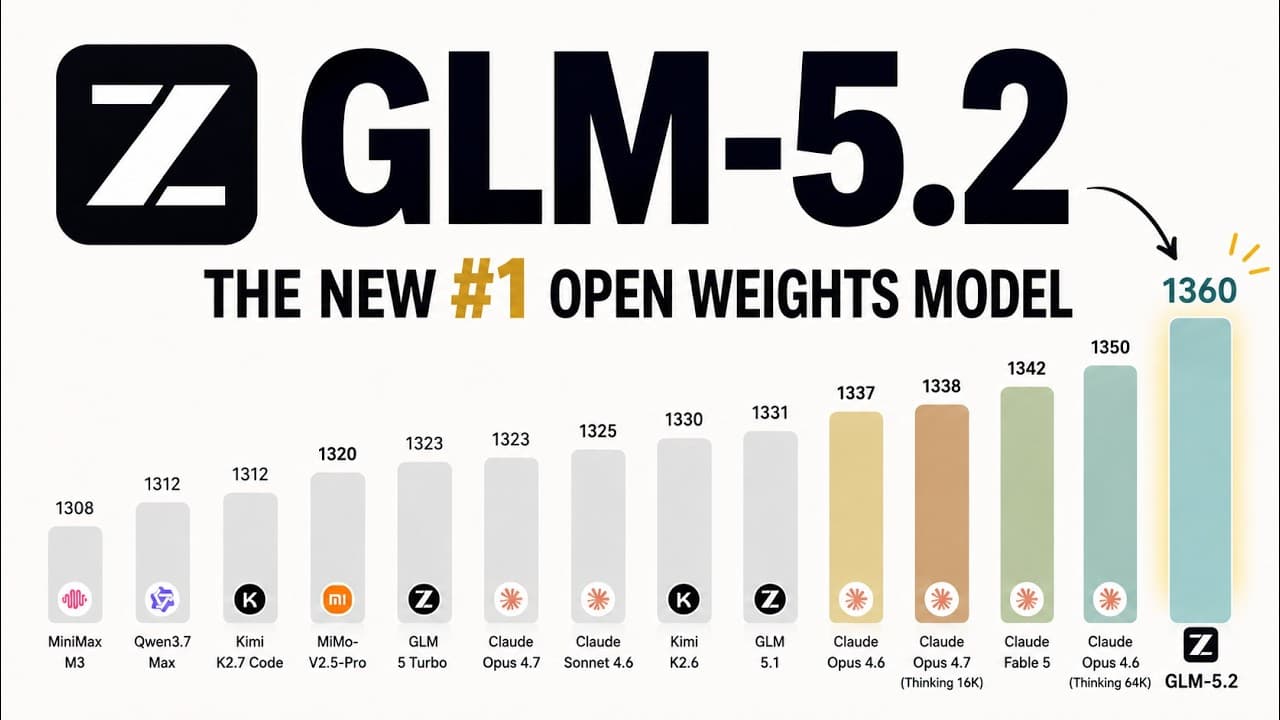
The interesting part is not just "another big open model." It is the way Z.ai is aiming straight at the pain point most coding agents still trip over: remembering enough of a real project to keep working without losing the plot.
Key Takeaways
- GLM-5.2 supports 1M context and 128K output tokens for project-scale engineering tasks (Z.ai docs, 2026).
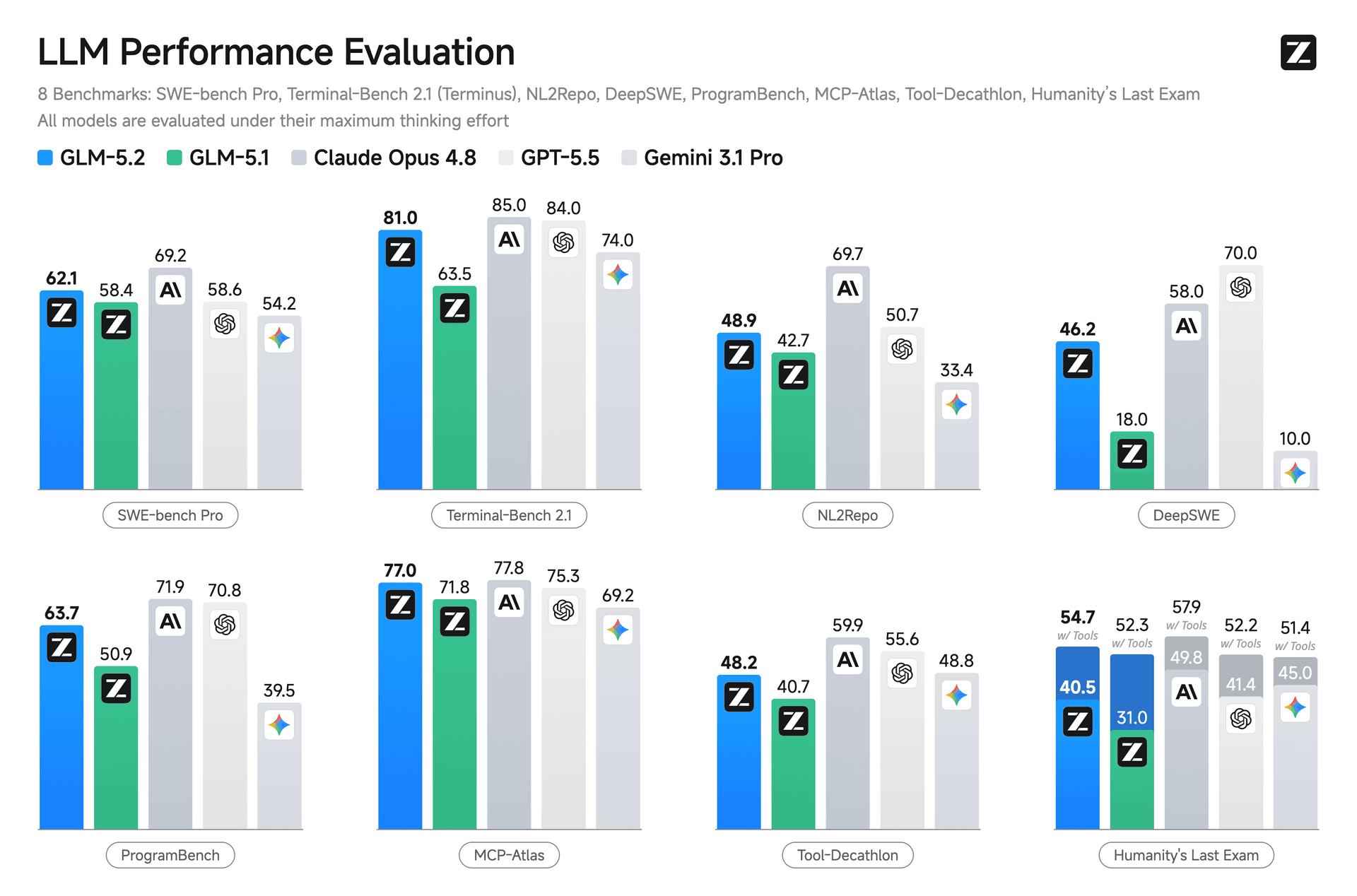
- Z.ai reports 62.1 on SWE-bench Pro and 81.0 on Terminal-Bench 2.1, ahead of GLM-5.1 on both tests (Z.ai GitHub, 2026).
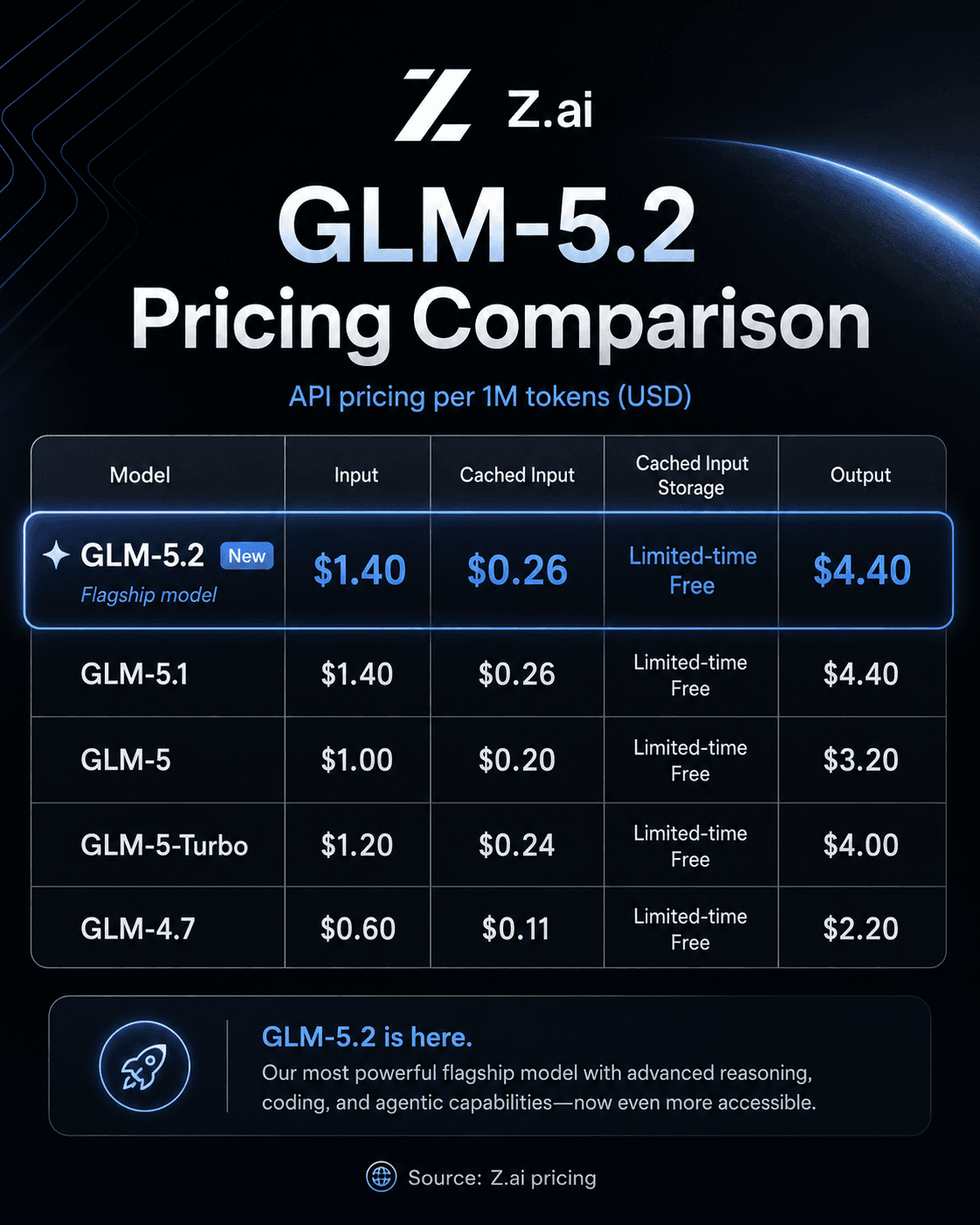
- API pricing is $1.40 per 1M input tokens and $4.40 per 1M output tokens (Z.ai pricing, 2026).
- The open model is huge: Z.ai lists 744B-A40B downloads in BF16 and FP8 forms, so local use is serious infrastructure, not laptop tinkering.
In June 2026, Z.ai described GLM-5.2 as a flagship model with 1M context and 128K maximum output tokens, built for project-scale engineering workflows (Z.ai GLM-5.2 overview, 2026). The company frames it as a "long-horizon" model: one that can read a large codebase, retain architectural constraints, then carry those decisions through multi-step coding work.
Key facts:
The short version: GLM-5.2 is not trying to be a general media model. It is built for agentic engineering: audits, refactors, migrations, cross-file changes, and long-running tasks that require memory across many steps.
As of June 2026, GLM-5.2 is best understood as a long-context coding and agentic engineering model, not a multimodal assistant. Its headline spec is the combination of 1M context and 128K output, both aimed at keeping large software tasks coherent across many turns.
In 2026, Z.ai says GLM-5.2's 1M-token context is intended to hold whole-project context, including module boundaries, API contracts, directory structures, and historical engineering decisions (Z.ai GLM-5.2 overview, 2026). That matters because coding agents usually fail less from missing syntax and more from losing architectural memory halfway through a task.
The useful mental model is not "bigger prompt." It is "less context bookkeeping." If a model can keep a backend, frontend, tests, docs, configuration, and repository conventions in scope, the human operator spends less time re-pasting files and more time judging decisions. That is exactly where coding agents start to feel like junior engineers rather than autocomplete.
Z.ai's own suggested first test is a project-level audit: ask the model to read the current project and output architecture, module responsibilities, API contracts, data flows, call chains, technical debt, and constraints. That is a good benchmark prompt because it reveals whether the model merely scanned files or actually built a stable map of the system.
There is still a catch. A 1M context window can make a bad prompt more expensive. It can also hide weak retrieval habits. The teams that benefit most will still structure their repo context: clear README files, tests, architecture notes, and a tight CLAUDE.md or AGENTS.md.
In 2026, Z.ai reports 62.1 on SWE-bench Pro, 81.0 on Terminal-Bench 2.1, and 82.7 on Terminal-Bench 2.1 with the best reported harness for GLM-5.2 (Z.ai GitHub README, 2026). Those are launch-table numbers, not your production workload, but they show a real jump over GLM-5.1.
The comparison that matters most is GLM-5.2 versus GLM-5.1. Z.ai says Terminal-Bench 2.1 moved from 62.0 to 81.0, while SWE-bench Pro moved from 58.4 to 62.1 (Z.ai GitHub README, 2026). SWE-bench improved modestly. Terminal-Bench moved sharply. That tells you where the real product claim sits: long-running terminal and agent workflows, not just patch generation.
GLM-5.2's most useful launch signal is the gap between its coding benchmarks and its long-context design. In 2026, Z.ai reports 62.1 on SWE-bench Pro, 81.0 on Terminal-Bench 2.1, and a 1M-token context window for project-scale work (Z.ai GitHub README, 2026). That combination suggests the model is aimed less at isolated coding puzzles and more at sustained engineering sessions where the model must inspect a repo, preserve constraints, call tools, and keep going for many turns. In other words, the benchmark to reproduce is not one patch. It is whether GLM-5.2 can keep a real codebase coherent after the fifth or tenth change request. That is also why teams should compare it against multi-step maintenance tickets, not single-file coding prompts alone.
Use the benchmark table as a shortlist signal, not a procurement decision. Z.ai's own footnotes say several evaluations used special harnesses, high reasoning effort, long contexts, and large output budgets. That is fair for testing a long-horizon model, but it also means you should reproduce the setup before claiming the same result.
In 2026, Z.ai lists GLM-5.2 API pricing at $1.40 per 1M input tokens, $0.26 per 1M cached input tokens, and $4.40 per 1M output tokens (Z.ai pricing, 2026). That is aggressive for a flagship long-context coding model, especially if your workload benefits from context caching.
The simplest path is the hosted API. Z.ai's docs show GLM-5.2 under the language model list with standard capabilities like function calling and structured output. The local path is more serious. The GitHub README lists GLM-5.2 and GLM-5.2-FP8 as 744B-A40B downloads, with deployment support for SGLang, vLLM, Transformers, KTransformers, Unsloth, and Ascend NPU inference stacks (Z.ai GitHub README, 2026).
That split is important. Hosted GLM-5.2 is easy to test. Self-hosted GLM-5.2 is an infrastructure project. If you read "open source" as "runs on my gaming laptop," you will be disappointed. If you read it as "the weights are available and the model can be deployed by teams with serious hardware," the story gets more useful.
In 2026, GLM-5.2's open release is best viewed as deployable by AI infrastructure teams, not hobbyist local users. The README lists 744B-A40B BF16 and FP8 variants, while Hugging Face reports nearly 99K downloads in the last month, showing early ecosystem interest.
In 2026, Hugging Face shows GLM-5.2 with an MIT model license, 2.64K likes, and 98,994 downloads last month (Hugging Face model card, 2026). That is enough adoption signal to take it seriously, but not enough to skip careful evaluation, especially for production agents that can modify code or call tools.
In our experience, the benchmark score is rarely the deciding factor when teams evaluate coding models for client workflows. The hard questions are more operational: does it follow repository rules, avoid scope creep, run tests, produce small diffs, and stop when it hits uncertainty? GLM-5.2 is explicitly aimed at those long-horizon behaviors, which makes it worth testing against real tickets, not synthetic prompts.
The open-source angle also has nuance. The model card says MIT, while the GitHub repo shows Apache-2.0 for the repository code. That is not a blocker, but legal teams should inspect the exact artifacts they plan to use: weights, inference code, scripts, examples, and any third-party dependencies.
There is also the safety and cost side. A model that can hold a whole codebase and call tools can do more useful work, but it can also do more accidental damage. Start with read-only audits, then move to scoped PR tasks, then allow write access only inside a sandbox.
In 2026, Z.ai's docs recommend starting with a real codebase audit before asking GLM-5.2 to perform long-horizon refactoring across files (Z.ai GLM-5.2 overview, 2026). That is the right adoption order: measure comprehension first, then trust it with changes.
The best GLM-5.2 test is not "build me an app." It is "repair this ugly, constrained, half-documented subsystem without breaking behavior." Long-context models prove themselves when they keep boring constraints alive across many steps. That is where most coding agents still crumble.
When we tested similar long-context coding agents on production-style repositories, the useful signal was not whether they could generate more code. It was whether they preserved the existing design under pressure: no accidental API changes, no new dependency sprawl, no skipped tests, and no edits outside scope. GLM-5.2's 1M context makes that kind of evaluation more realistic because you can include the surrounding system instead of reducing the task to a few isolated files.
GLM-5.2 is one of the clearest signs that the open-model race is moving from chat quality to sustained engineering work. The headline specs are simple: 1M context, 128K output, strong coding benchmarks, open weights, and low hosted pricing. The deeper claim is more interesting: a model that can keep a large software system in mind long enough to do useful work inside it.
The smart move is a practical pilot. Put GLM-5.2 against your current coding model on one real repo, one bounded task, and one clear test suite. If it holds architecture, constraints, and verification better over time, it earns a place in your stack. If it only looks good on benchmark tables, you will know quickly.
From coding agents to long-context workflows, we help you pick, test, and deploy the model setup that actually performs.
Continue exploring these related topics
Ox Alpha appeared free on OpenRouter with a 1M-token window and 16 trillion tokens processed in three days. Nobody has confirmed who built it.

Claude Opus 5.5 scores 58 on the Artificial Analysis index against GPT-6 Astra's 53 and Sol's 48. But Sol costs half as much and runs faster. Full breakdown.
GPT-6 Astra scores 72.6% on OSWorld 2.0 and costs $10/$50 per million tokens. Here's what OpenAI's AGI-era model actually changes, and what it doesn't.