Insurance
AI in insurance and insurance software development
By Yash Soni, Founder & CEO, Apex36Updated
In short
Apex36 is an insurance software development company that puts AI in insurance operations where reading is the bottleneck: claims intake and triage, document extraction, policy admin tools and broker portals, with a person reviewing every uncertain case. We build to the controls your compliance team sets for GDPR, FCA rules and US state insurance data rules. A first automated workflow starts from $5,000.
Key facts
| Starting price | First workflow or MVP from $5,000; AI development from $8,000 |
|---|---|
| Typical first milestone | Assessment report by email within 48 hours; first workflow typically live in 2 to 4 weeks |
| Engagement model | Free AI readiness assessment, a fixed-price first workflow, then optional monthly support or a monthly team |
| Markets | US, UK, Australia, Singapore, UAE |
| Built for | US state insurance data rules, FCA rules (UK), GDPR |
AI in insurance: where it pays off first
Insurance runs on documents: claim forms, photos, repair estimates, medical reports, policy wordings and broker submissions. AI in insurance is most useful where people spend their day reading those documents to decide where a case goes next. It can pull the key fields out of a claim, check them against the policy record, spot what is missing and draft the next message. The decision to pay, decline or investigate stays with a claims handler or an underwriter, and the system records what the AI suggested and what the person decided.
Insurance claims automation
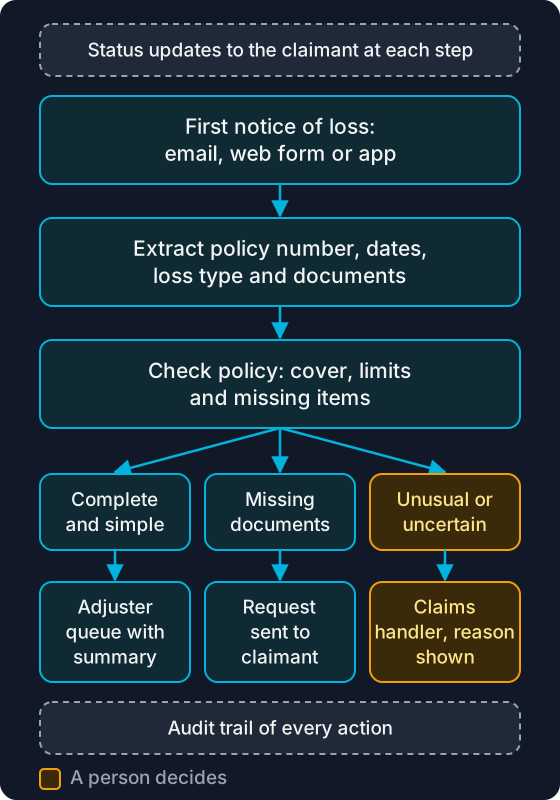
How we would build it. A first notice of loss arrives by email, web form or app. The system extracts the policy number, dates, loss type and attached documents, then looks up the policy and checks cover, limits and missing information. Simple, complete claims go straight to an adjuster's queue with a summary; incomplete ones trigger a request for the missing documents; anything unusual or uncertain goes to a claims handler with the reason shown. The claimant gets status updates at each step, and every action lands in an audit trail.
Insurance automation beyond claims
Claims are the obvious target, but the inbox is often the bigger one. Underwriting submissions, broker questions, renewal documents and certificate requests all arrive by email and get sorted by hand. We build triage that reads each message, classifies it, files it in the right place and routes it to the right team, with a person reviewing what the system is unsure about.
The same kind of work, in pharma: for a global pharma company, we built inbox automation that classifies a high-volume enterprise Outlook mailbox and routes each email to the right folder, with an audit trail per email. Insurance inboxes need the same pattern: rules where the logic is fixed, AI where reading is needed, and a log for every decision.
Insurance software development company: policy tools and broker portals
Large policy administration platforms do the core job, but carriers, MGAs and brokers still run a lot of work beside them: quote and bind steps tracked in spreadsheets, broker portals that are just a shared inbox, and reports rebuilt by hand. We build that software around your policy system, connected through its APIs or file exports: broker portals for submissions and documents, internal tools for underwriters and claims teams, and reporting that builds itself.
We have built insurance software before: in 2023 we built eOxygen, a MEAN-stack insurance application (MongoDB, Express, Angular, Node.js) on AWS covering customer records, policy data and workflow tooling.
Insurance app development
A customer-facing insurance app should let a policyholder do the three things they call about most: see their policy documents, report a claim with photos, and check the claim's status. We build insurance apps on a secure web or mobile front end, with sign-in, document storage and a claims flow that feeds the same triage your team already uses, so the app reduces calls instead of creating a second queue. An insurance app MVP starts from $5,000 for one core flow.
Built for insurance data rules
Policyholder data includes health, financial and claims history, so access must be narrow and every view recorded. We build to the controls your compliance team sets:
- Data kept in your cloud account and region, encrypted in transit and at rest
- Access limited by role and line of business, with access logs
- Append-only records of every automated suggestion and every human decision
- Retention and deletion rules applied in code, not by hand
US state insurance data rules, FCA rules and GDPR obligations stay with your organisation; we document how each control is met so your compliance team can review it.
What insurance software costs
A first automated insurance workflow, such as claims intake triage for one channel, starts from $5,000. An insurance app MVP also starts from $5,000, and AI development from $8,000. More channels, policy system integrations and high volumes move the price up. Model and cloud costs are billed to your own accounts. You get a fixed quote in writing after the free assessment. See pricing.
How we would build it: claims automation
- First workflow
- claims intake and triage for one channel (email or web form), chosen in the free assessment.
- Where it runs
- your own cloud account, connected to your policy system.
- What you see
- an adjuster queue with summaries, a handler queue for uncertain cases, an audit trail and a weekly demo.
- What you own
- the code, the runbook and the cloud resources.
Proof from our work
Insurance · MEAN
eOxygen Insurance
A MEAN-stack insurance application (MongoDB, Express, Angular, Node.js) on AWS, covering customer records, policy data and workflow tooling. Built in 2023.
Read the case studyPharma · Inbox automation
Pharma inbox automation (transferable proof, pharma; pilot)
The same kind of work in another industry: for a global pharma company, through a pharma enterprise customer, 268 rules route an enterprise mailbox into 60 folders, with an audit trail per email. About 2,244 emails processed, averaging 40 seconds from received to resolved. POC.
Read the case study
Frequently asked questions
Insurers use AI to read and sort: extracting details from claim forms and documents, checking them against policy data, triaging claims and submissions, and drafting customer messages. The safe pattern keeps a claims handler or underwriter in charge of every decision and logs what the AI suggested.
Insurance claims automation uses software to take in a claim, extract its details, check cover and missing information, and route it to the right adjuster. Simple claims move faster, and people focus on the complex or uncertain ones.
At Apex36, a first automated insurance workflow or an app MVP starts from $5,000, and AI development from $8,000. Channels, integrations and volume add to that. You get a fixed quote in writing after a free assessment.
We do not build it that way. AI prepares the claim, checks it and suggests the next step; a claims handler makes decisions to pay, decline or investigate, and the system logs both the suggestion and the decision.
Yes. In 2023 we built eOxygen, a MEAN-stack insurance application on AWS for customer records, policy data and workflow tooling. Our claims automation approach uses the same inbox triage and audit-trail pattern we built for a global pharma company.
Yes. We connect through its APIs or file exports and build the tools around it, such as claims intake, broker portals and reporting, rather than replacing it.
In accounts you control. We deploy into your own AWS, Azure or GCP account, in the region you choose, with role-based access, encryption and access logs.
Services for this industry: Workflow automation · AI consulting and development · SaaS and MVP development
Find out what to build first
Start with the free AI readiness assessment and get a written report by email, or book a 30-minute strategy call with the founder.