Legal Tech
AI for law firms and legal software development
By Yash Soni, Founder & CEO, Apex36Updated
In short
Apex36 builds AI for law firms and legal tech companies: document review support, eDiscovery platforms, matter intake and inbox triage, with an attorney able to override every AI decision. We helped build DecoverAI's legal AI platform, and we build and run TriageGrid, our own email triage product for law firms. Legal AI development starts from $8,000, and a first automated workflow from $5,000.
Key facts
| Starting price | Legal AI from $8,000 per project; first automated workflow from $5,000 |
|---|---|
| Typical first milestone | Discovery typically in under a week; first shippable milestone typically in 1 to 3 weeks |
| Engagement model | Fixed-scope project, or a monthly team |
| Markets | US, UK, Australia, Singapore, UAE |
| Built for | Client confidentiality and attorney-client privilege; GDPR for UK and EU matters |
AI for law firms: where it helps first
Law firm work is reading work: discovery sets, intake forms and every email in the shared inbox. AI earns its place where the reading volume is high and a lawyer can check every output before it matters.
Three places usually come first:
- First-pass document review: sorting documents by relevance and flagging likely privilege, so attorneys start with the documents that need them
- Matter intake: turning an intake form or email into a structured summary with parties, dates and the conflicts to check
- Inbox triage: classifying incoming mail by matter, deadline and type, and alerting the right person when something is urgent
AI should not give legal advice, and it should not make a privilege call that no attorney has seen. We design every legal tool so a lawyer signs off the decisions that carry risk.
AI legal document review with attorney override
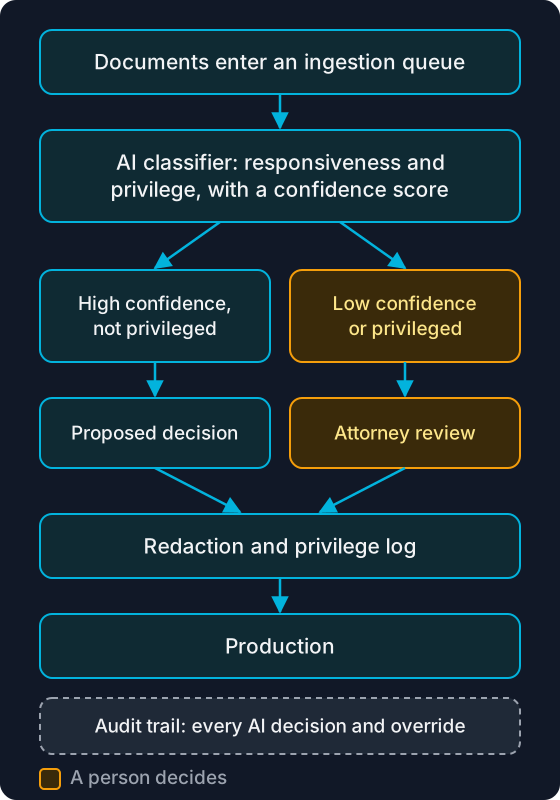
Document review is where legal AI pays for itself or fails in front of a judge. The pattern we build has four parts. A classifier marks each document for responsiveness and privilege and attaches a confidence score. Low-confidence and privileged documents go to an attorney queue instead of being decided automatically. Redactions are proposed by the system and approved by an attorney. Every decision, whether made by the model or overridden by a person, is written to an audit trail, so the review can be explained later.
DecoverAI's platform, which we helped build, works this way: AI classification with confidence scores, attorney override on every AI decision, automated redaction, Bates numbering and privilege logs.
eDiscovery platforms and the infrastructure behind them
Large matters break naive AI systems. A production can mean hundreds of thousands of documents arriving at once, in mixed formats, under a deadline. We build ingestion as queues so documents are processed in the background and nothing is dropped, semantic search with a vector database so reviewers find documents by meaning instead of exact words, and retrieval-augmented generation (RAG) so answers cite the documents they came from. For DecoverAI we built the infrastructure on AWS EKS with Pinecone for vector search, sized for matters of more than a million documents.
Matter intake and legal inbox triage
Shared firm inboxes such as intake@ and billing@ are where deadlines get missed. TriageGrid, our own product, connects to Microsoft 365 and classifies each incoming Outlook email into categories such as intake, court deadlines, billing and conflicts. It then runs the action chain the firm chose for that category: tag, move, forward, reply or flag. Urgent items raise an alert in Teams or Slack, and one-click corrections from attorneys teach it the firm's own categories.
When a firm needs its own matter types, filing into its document management system or a stricter data policy, we build a custom version inside the firm's own cloud account.
Confidentiality and privilege by design
Client files are the reason firms hesitate to use AI. We design around that:
- Documents stay in your own cloud account, in the region you choose
- Data is encrypted at rest, and access to each matter is limited by role
- Where documents cannot go to an outside model API at all, we run an open-weight model inside your account (see private LLM)
- Every AI decision and every human override is logged with who, what and when
- Your matter data is kept out of shared prompts, examples and other clients' systems
Professional responsibility stays with the firm; we build to the controls your general counsel and IT team set.
Legal AI solutions: buy, build or both
Ready-made legal AI products suit standard tasks such as drafting help or research, and many firms should start there. Building makes sense when your workflow, data or confidentiality rules do not fit a product: your own review categories, an intake flow tied to your practice areas, or documents that never leave your servers. Often the answer is both, and the free assessment tells you which.
Legal software development for legal tech companies
Legal tech startups need engineers who understand both the product and the stakes. We build MVPs from $5,000 and AI platforms from $8,000, then stay on as a monthly team, as we did for 13 months with DecoverAI.
What AI for a law firm costs
Legal AI projects start from $8,000, and a first automated workflow, such as inbox triage for one shared mailbox, from $5,000. Large document volumes, private model hosting and integrations with your document management system move the price up. Model and cloud costs are billed to your own accounts. You get a fixed quote in writing after discovery. See pricing.
Proof from our work
Legal Tech · eDiscovery
DecoverAI
Legal AI platform with RAG search, AI classification and privilege review over case documents, on Pinecone and AWS EKS. Apex36 helped build the infrastructure and generative AI platform. The client's results: DecoverAI raised a $2M+ seed, and the platform runs at 10+ US law firms.
Read the case studyTriageGrid (our own product)
AI email triage for law firms on Microsoft 365: classifies inbound Outlook mail, detects court deadlines and runs the firm's action chains. Built and run by Apex36.
Visit the site
What clients say about working with us
“One of the hardest-working and meticulous engineers I have encountered... helped build the infrastructure and Generative AI platform that is now deployed in large law firms throughout the United States... We eventually raised 2M+ in funding with the help of his efforts.”
Frequently asked questions
Law firms use AI mostly for reading-heavy work: first-pass document review, summarising intake, sorting shared inboxes and searching large document sets by meaning. The useful systems keep an attorney in charge of every decision that carries legal risk and log what the AI did.
Yes, as a first pass. AI can classify documents for responsiveness and likely privilege with a confidence score, so attorneys review the uncertain and privileged ones first. It should not make final privilege calls on its own; an attorney approves or overrides each one.
It can be, if the system is built for it. We keep documents in your own cloud account, encrypt them at rest, limit access by role and log every AI decision. Where documents must not reach an outside model API, we run a private model inside your account.
No. It changes where attorney time goes. AI sorts and flags, attorneys decide, and the audit trail shows which was which. That split is also what makes the review defensible later.
At Apex36, legal AI projects start from $8,000 and a first automated workflow from $5,000. Document volume, private model hosting and integrations add to that. You get a fixed quote in writing after discovery.
Buy when the task is standard and a product fits your data rules. Build when your workflow, categories or confidentiality rules do not fit, or connect a product to your systems with a custom integration. Many firms end up doing both.
Yes. TriageGrid, our own product, classifies Outlook email into categories such as intake, court deadlines and billing, then tags, moves, forwards or flags it. For firm-specific rules we build a custom version in your cloud account.
Yes. We build MVPs and AI platforms, then work as a monthly team. We worked with DecoverAI for 13 months on its legal AI platform.
Services for this industry: AI consulting and development · Private LLM · Workflow automation · SaaS and MVP development
Find out what to build first
Start with the free AI readiness assessment and get a written report by email, or book a 30-minute strategy call with the founder.