

LLMs
AI Productivity
What Is TypeSafe Jev? The ChatGPT Co-Creator's Silent AI
TypeSafe AI's Jev returns typed decisions in 0.4s at $0.0004 per case, matching GPT-5.6 Terra's 67.9% at 1/76th the cost. Where it fits, and where it doesn't
•11 min read
ChatGPT Health helps you understand lab results, fitness data, and wellness trends using AI—clear explanations, strong privacy, and zero late-night panic.
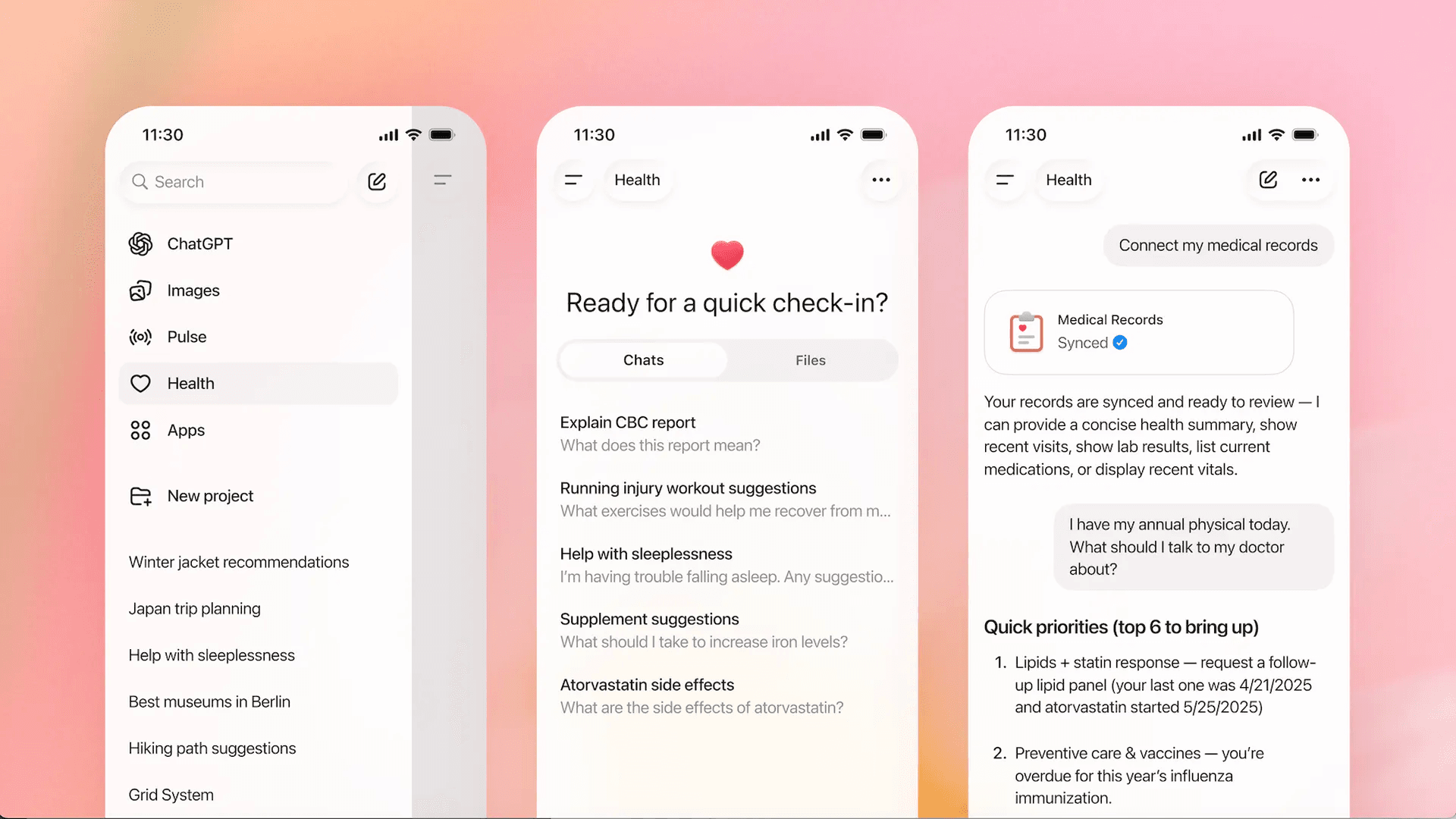
On January 7, 2026, OpenAI announced ChatGPT Health, a dedicated space inside ChatGPT for medical questions that connects to your records and wellness apps (TechCrunch, 2026). The launch number is striking: OpenAI says more than 230 million people already ask ChatGPT health questions every week. So this isn't a new behavior, it's OpenAI building structure around something people were already doing in the regular chat box. Here's what ChatGPT Health actually does, where it helps, and the privacy fine print worth reading first.
Key Takeaways
- OpenAI says 230 million people ask ChatGPT health questions weekly, and 40 million do so daily (TechCrunch, 2026; Healthcare Dive, 2026).
- It connects medical records (via b.well in the US) and syncs apps like Apple Health, MyFitnessPal, Peloton, and Weight Watchers (Fox News, 2026).
- Health chats live in a separate, encrypted space and are excluded from model training by default, though OpenAI holds the keys (The Register, 2026).
- It is explicitly not a doctor: OpenAI says it is not for diagnosis or treatment (TechRadar, 2026).
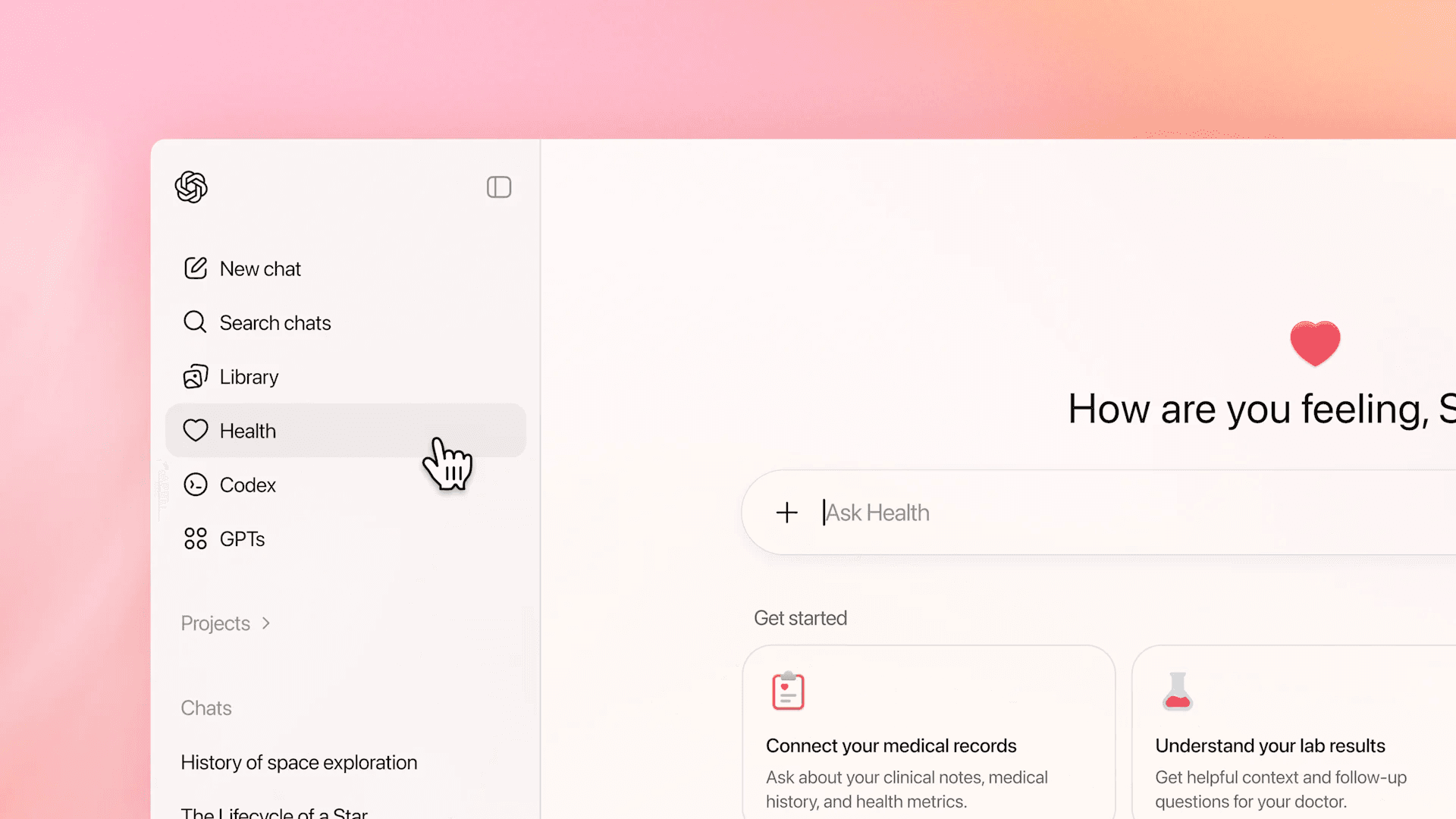
ChatGPT Health is a separate tab inside ChatGPT built specifically for health and wellness questions, grounded in your own data instead of generic web results. It can interpret lab results in plain language, summarize doctor's notes, read wearable data, and help you prepare questions for an upcoming appointment (Fox News, 2026). OpenAI says it built the feature with more than 260 physicians across roughly 60 countries.
The shift here is grounding. A normal ChatGPT answer about back pain draws on general training. A ChatGPT Health answer can pull from your actual blood panel, your step count, and the note your doctor left after your last visit. That's the difference between a well-read stranger and a friend who has seen your chart. It doesn't make the tool a clinician, but it does make the answers specific to you.
Because it formalizes a habit hundreds of millions of people already have. OpenAI reports that more than 230 million people ask ChatGPT health questions each week, and a companion report puts daily health usage at 40 million people, with more than 5% of all ChatGPT messages being healthcare-related (Healthcare Dive, 2026). Notably, about 70% of those health conversations happen outside normal clinical hours.
That last figure explains the product. People have health questions at 2 a.m., when no clinic is open, and they were already typing them into ChatGPT. By the numbers, OpenAI says 40 million people use ChatGPT daily for health questions, and roughly 70% of those chats happen outside typical office hours (Medical Economics, 2026). ChatGPT Health is OpenAI's bid to own that off-hours moment with something safer and more structured than a raw chat window. It arrives as the AI-in-healthcare market is projected to grow sharply.
Global AI-in-healthcare market (USD billions) 2025 $37.0B 2026 $51.2B Source: Grand View Research (2026)
Private by design, with one important asterisk. OpenAI says health conversations, connected apps, and uploaded files sit in a separate, isolated space with purpose-built encryption, and that Health chats are excluded from training its foundation models by default (Fox News, 2026). For most people, that's a meaningful upgrade over pasting lab results into a general chat.
The asterisk comes from The Register, which notes OpenAI, not the user, holds the encryption keys and could decrypt data if legally compelled, citing existing court orders to produce ChatGPT logs (The Register, 2026). So "encrypted and not used for training" is a real protection, but it isn't the same as data only you can unlock. If you work in a regulated field or simply want tighter control, treat ChatGPT Health as convenient, not confidential, and keep your most sensitive records out of it until you've read OpenAI's terms yourself.
It connects to your records and a growing list of wellness apps, which is what makes its answers personal. In the US, medical records flow in through a partnership with b.well, described as the largest network of live connected health data for US consumers (Medical Economics, 2026). On the wellness side, it syncs with a wide set of consumer apps.
| Category | Connected services |
|---|---|
| Medical records (US) | Patient portals via b.well |
| Fitness and activity | Apple Health, Peloton, AllTrails |
| Diet and weight | MyFitnessPal, Weight Watchers |
| Labs and other | Function, Instacart |
Source: Fox News (2026), Unite.AI (2026).
Pulling these into one place is the actual value. Your steps, meals, lab work, and care instructions usually live in separate apps that never talk to each other. ChatGPT Health reads across them, so a question like "is my resting heart rate trending up?" can draw on real data instead of a guess. That cross-app view is genuinely useful, as long as you remember it's a pattern-spotter, not a diagnostician.
No, and OpenAI is unusually direct about it. The company states ChatGPT Health is not intended for the diagnosis or treatment of any condition, and in-product reminders label responses as informational only, not medical advice (TechRadar, 2026). It's built to support care, not stand in for it.
There's good reason for the caution. The Register points to a documented case of a delayed stroke diagnosis after a patient leaned on ChatGPT, and to known issues like AI sycophancy and bias (The Register, 2026). So what's it good for? Understanding what your doctor already told you, tracking trends over time, and walking into your next appointment with sharper questions. Used that way, it augments you. Used as a substitute for professional care, it's a liability.
The smartest way to think about ChatGPT Health is as a translation layer, not a second opinion. Its strength is turning a confusing lab report or doctor's note into plain language and surfacing patterns across your apps. Its weakness is exactly the thing a doctor does that an app can't: take responsibility for a diagnosis. Keep the tool on the translation side of that line.
Chat with us about making your personal health data easy to understand.
Continue exploring these related topics
TypeSafe AI's Jev returns typed decisions in 0.4s at $0.0004 per case, matching GPT-5.6 Terra's 67.9% at 1/76th the cost. Where it fits, and where it doesn't

On a 12 GB test repository, xAI's Grok Build CLI sent about 192 KB to the model and 5.10 GiB to a Google Cloud Storage bucket, What xAI Grok Build CLI actually sends to xAI: a wire-level analysis.

Flash is open-weights and local-ready. FlashX is the hosted speed tier. Compare stats, context length, pricing, and best use-cases.