On June 26, 2026, OpenAI previewed GPT-5.6 in three tiers, and the flagship posted a number that stops you mid-scroll: 91.9% on Terminal-Bench 2.1, a benchmark built around real command-line engineering work.
Sol, Terra, Luna — the same shorthand as three well-known crypto tickers. This guide cuts past the meme to the decision that actually matters: which of the three models belongs in your stack, and why.
Key Takeaways
GPT-5.6 Sol scored 91.9% on Terminal-Bench 2.1 in its top "ultra" mode, edging Claude Mythos 5's 88% (OpenAI, 2026).
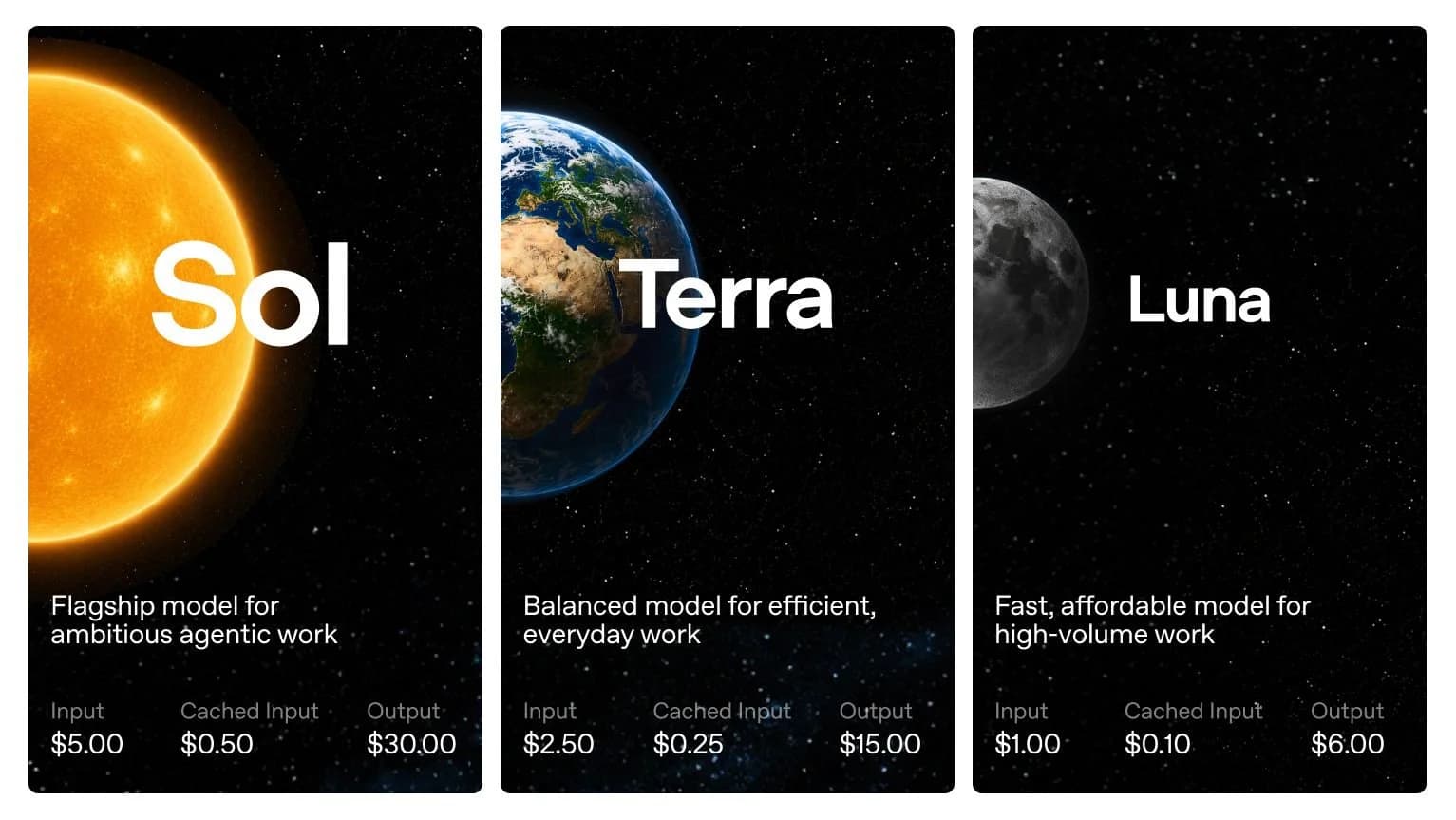
Three tiers, three price points per 1M tokens: Sol ($5/$30), Terra ($2.50/$15), Luna ($1/$6) (DataCamp, 2026).
Access is limited to ~20 vetted partners after OpenAI briefed the US government; general release is "coming weeks" (VentureBeat, 2026).
Terra is the quiet story: GPT-5.5-class quality at roughly half the cost.
What Exactly Did OpenAI Release?
OpenAI released a three-model family, not a single model. In 2026, the company began a limited preview of GPT-5.6 Sol (the flagship), GPT-5.6 Terra (a balanced mid-tier), and GPT-5.6 Luna (the fast, low-cost tier), per OpenAI's preview announcement (OpenAI, Previewing GPT-5.6 Sol, June 2026). Each targets a different point on the cost-versus-capability curve.
Think of it less as "the new model" and more as a menu. Sol is the high-ceiling reasoner built for frontier coding, scientific work, and long-horizon agentic tasks. Terra is the everyday workhorse. Luna is the volume play — the one you reach for when latency and unit economics matter more than squeezing out the last few benchmark points.
According to OpenAI's June 2026 preview, the GPT-5.6 family advances the frontier across software engineering, computer use, professional knowledge work, scientific research, and cybersecurity (OpenAI, 2026). That breadth is the point: one family, tuned for the spread of work most teams actually run.
How Good Is GPT-5.6 Sol at Coding?
In 2026, GPT-5.6 Sol reached 91.9% on Terminal-Bench 2.1 using its new "ultra" mode, and 88.8% in standard mode both ahead of Claude Mythos 5's 88.0% on the same test (DataCamp, 2026). Terminal-Bench measures multi-step, command-line engineering tasks, so the score speaks directly to agentic coding rather than toy snippets.
The spread across the family is worth noting. On the same benchmark, Luna posted 84.3% and Terra 82.5% — meaning even the budget tier lands within single digits of the frontier (DataCamp, 2026). For a lot of routine code generation, that gap won't justify Sol's price.
The "ultra" mode behind the 91.9% is itself notable: OpenAI describes it as a subagent architecture that spins up parallel reasoning rather than a single chain (DataCamp, 2026). Sol also unlocks a new max reasoning effort for extended thinking on hard problems.
What Does GPT-5.6 Cost, and Is Sol Worth the Premium?
GPT-5.6 is priced in three clear tiers per 1M tokens: Sol at $5 input / $30 output, Terra at $2.50 / $15, and Luna at $1 / $6 (DataCamp, 2026). Cached input reads keep a 90% discount, while cache writes bill at 1.25x the standard rate — a detail that matters once you run at scale.
Output tokens are where the real cost lives, and the gap is stark: Sol's output is 5x Luna's. For a chatbot fielding millions of short replies, that multiplier dwarfs any benchmark advantage. For a security audit that runs for hours and ships once, it's a rounding error.
So is Sol worth the premium? Only when the task ceiling demands it. In 2026, OpenAI positioned Terra as competitive with the previous flagship, GPT-5.5, at roughly 2x lower cost (DataCamp, 2026). If your current production prompts run fine on GPT-5.5, Terra is a near-automatic cost cut.
Which GPT-5.6 Model Should You Actually Use?
Pick the tier by task ceiling, not by instinct. As a rule of thumb for 2026: use Luna for high-volume, latency-sensitive work; Terra for standard production at GPT-5.5-class quality and lower cost; and Sol only for frontier reasoning, deep research, security work, or long-horizon agents (DataCamp, 2026).
Speed enters the equation too. A Cerebras-hosted version of Sol is slated to hit up to 750 tokens per second for select customers starting July 2026 (DataCamp, 2026). That changes the calculus for real-time agents, where Sol was previously too slow to feel interactive.
Here's the practical mapping we use:
Customer-facing chat, classification, extraction at scale → Luna. Cheap, fast, good enough.
Content generation, summarization, standard RAG → Terra. The new default for most production work.
Autonomous coding, security research, multi-hour agents, novel reasoning → Sol, in max or ultra mode.
Why Is GPT-5.6 So Locked Down at Launch?
Access is deliberately narrow. OpenAI opened GPT-5.6 to roughly 20 vetted organizations and shared the models and release plans with the US government at the administration's request before any wider rollout (VentureBeat, 2026). General API availability is planned for "the coming weeks," not launch day.
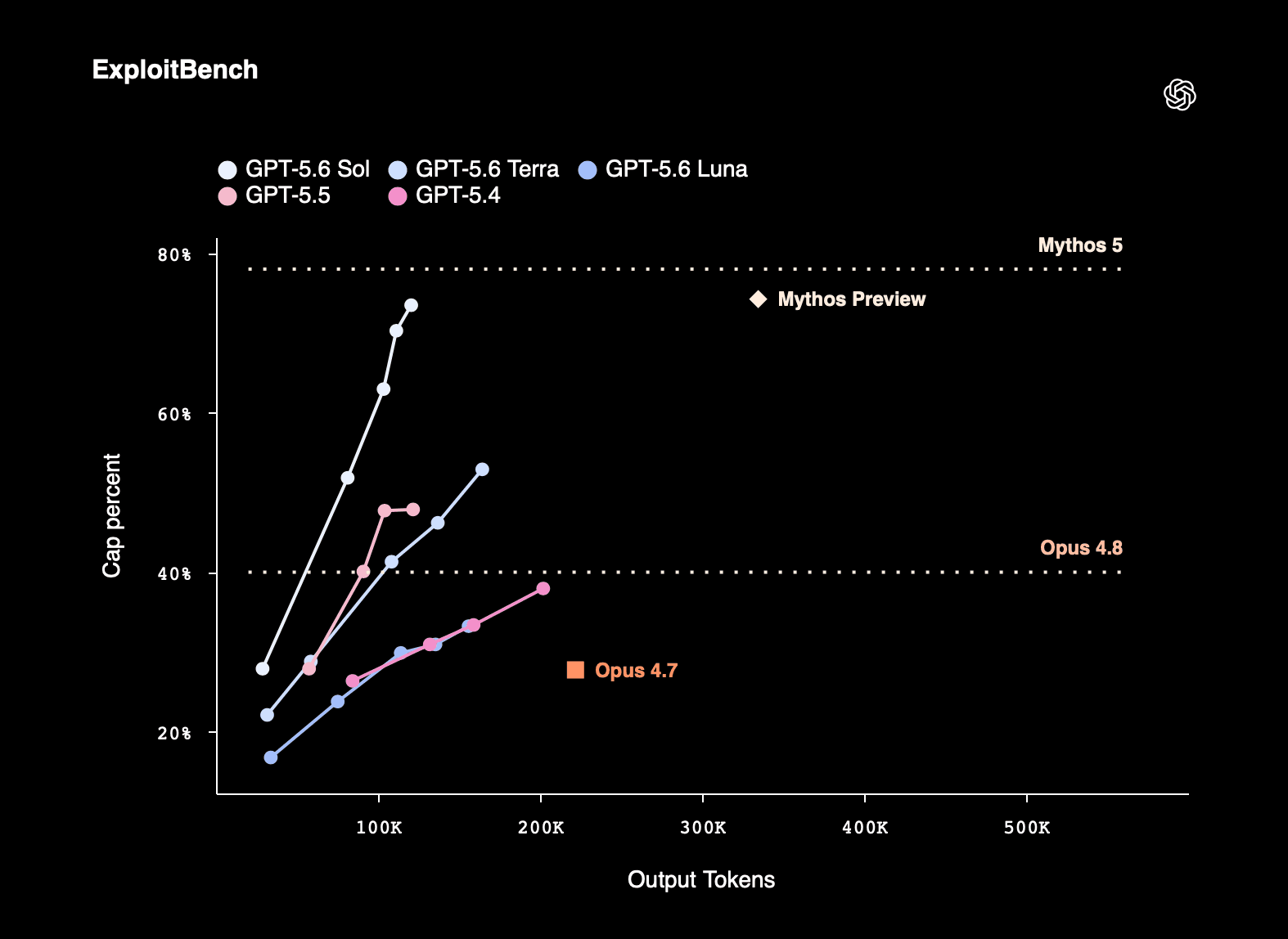
The caution traces to capability. GPT-5.6 Sol is OpenAI's strongest cybersecurity model yet, and on the ExploitBench evaluation it matched an unreleased "Mythos Preview" system while using only about one-third of the output tokens (DataCamp, 2026). Stronger offensive-security reasoning means a higher bar for safe release.
According to OpenAI's preparedness reporting in 2026, Sol does not cross the "Cyber Critical" threshold under its Preparedness Framework in browser-engine tests against Chromium and Firefox it surfaced bugs and exploitation primitives but did not autonomously produce a full-chain exploit under the conditions tested (OpenAI Help Center, 2026). An independent predeployment evaluation by METR accompanied the release (METR, 2026).
What's With the Sol, Terra, and Luna Names?
The names are astronomical Sun, Earth, Moon — but the crypto world heard tickers. In 2026, OpenAI's choice collided with Solana's "SOL" shorthand and the Terra/LUNA ecosystem whose 2022 collapse erased tens of billions in market value, sparking a wave of confusion and jokes (crypto.news, 2026).
Solana's official account leaned in, dubbing CEO Sam Altman "Sam Altcoinman" a jab that went viral within hours (CCN, 2026). OpenAI clarified that the names denote capability tiers and have no link to any cryptocurrency project.
It's a footnote to the technology, but a useful reminder: naming carries baggage you don't control. For builders, the only thing that matters is that "Terra" the model has nothing to do with "Terra" the failed stablecoin.
When Can You Get Access, and How Should You Prepare?
You likely can't use GPT-5.6 in production today, but you can be ready. As of June 2026, access sits with about 20 preview partners, and OpenAI has signaled general availability within weeks (VentureBeat, 2026). Some organizations will see the models in their picker before others.
Use the wait productively. Audit your current prompts, tag each workload by its true difficulty, and decide in advance which tier each one should target. When the gate opens, you'll cut over in hours instead of weeks.
Conclusion
GPT-5.6 isn't a single upgrade it's a portfolio, and that's the real shift. The three takeaways to carry forward:
Sol sets a new coding bar at 91.9% on Terminal-Bench 2.1, but its 5x output premium means you should reserve it for hard problems (OpenAI, 2026).
Terra is the value play GPT-5.5-class quality at roughly half the cost makes it the new default for most production work.
Routing beats picking. The teams that benefit most will build logic to send each request to the cheapest model that clears the bar.
Don't wait for general availability to plan. Map your workloads to tiers now, and you'll move fast when the gate opens.