

LLMs
AI Productivity
What Is TypeSafe Jev? The ChatGPT Co-Creator's Silent AI
TypeSafe AI's Jev returns typed decisions in 0.4s at $0.0004 per case, matching GPT-5.6 Terra's 67.9% at 1/76th the cost. Where it fits, and where it doesn't
•11 min read
Per-seat SaaS pricing assumes humans do the work. In the agent era, that costs you revenue. Here is the hybrid pricing playbook winning 2026 renewals.
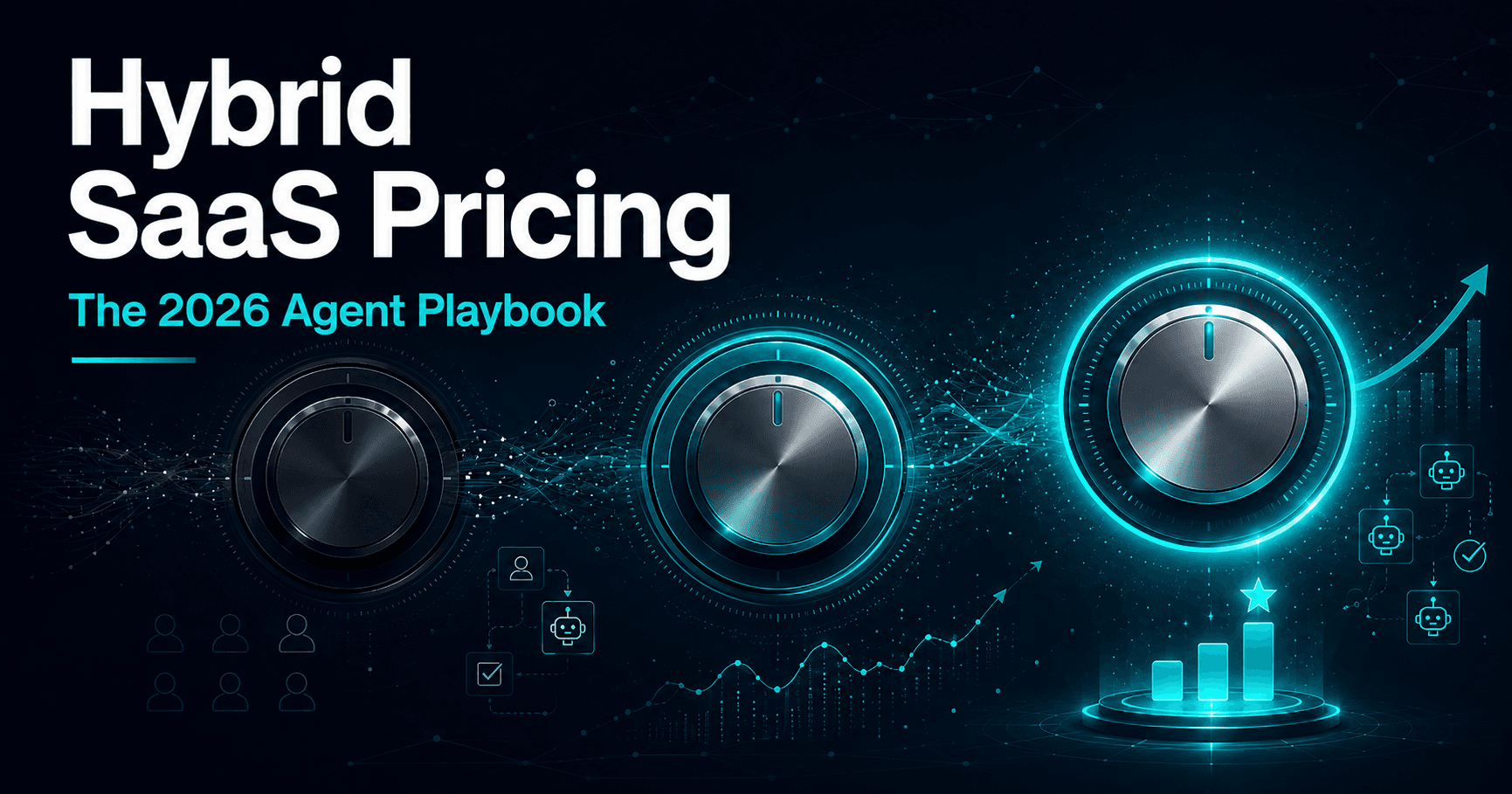
Per-seat SaaS has a quiet assumption baked into the price card: a human is doing the work. As of 2026, that assumption is wrong often enough that hybrid SaaS pricing is the fastest-growing model on the renewal table. Gartner's 2026 forecast pegs hybrid pricing adoption at 40% by year-end, up from under 5% in 2025. Companies that moved to hybrid report roughly 38% higher net revenue retention than those still on pure subscription. Zendesk now bills $1.50 per Automated Resolution. Intercom is at $0.99 per resolved ticket. Microsoft just shipped Agent 365 at $15/user/month on top of an E7 suite that lists at $99. The category leaders have all priced agent output. The question is whether your product has — and whether your renewals are slowly leaking the difference.
This post covers why per-seat broke, what the three live pricing modes look like, and how to repackage in 90 days without spooking procurement.
Per-seat pricing has an implicit unit of work — one human, one workstation, one set of decisions per day. That worked when SaaS was a productivity multiplier for human users. It breaks the moment software does the work itself.
Two things shifted in parallel this year. Agents got good enough to run multi-step workflows without human approval at every step — Deloitte's 2026 prediction has enterprise applications with embedded task-specific agents rising from under 5% today to 40% by year-end. And the cost side flipped: pure AI-first SaaS gross margins are running 50–60%, against 60–70% for the rest of public SaaS, because every interaction has a token bill attached.
Net effect: per-seat structurally undercharges power users and overcharges light ones. Agents widen the gap, because a power user's agent now triggers 50x the value-delivering work without buying 50x the seats.
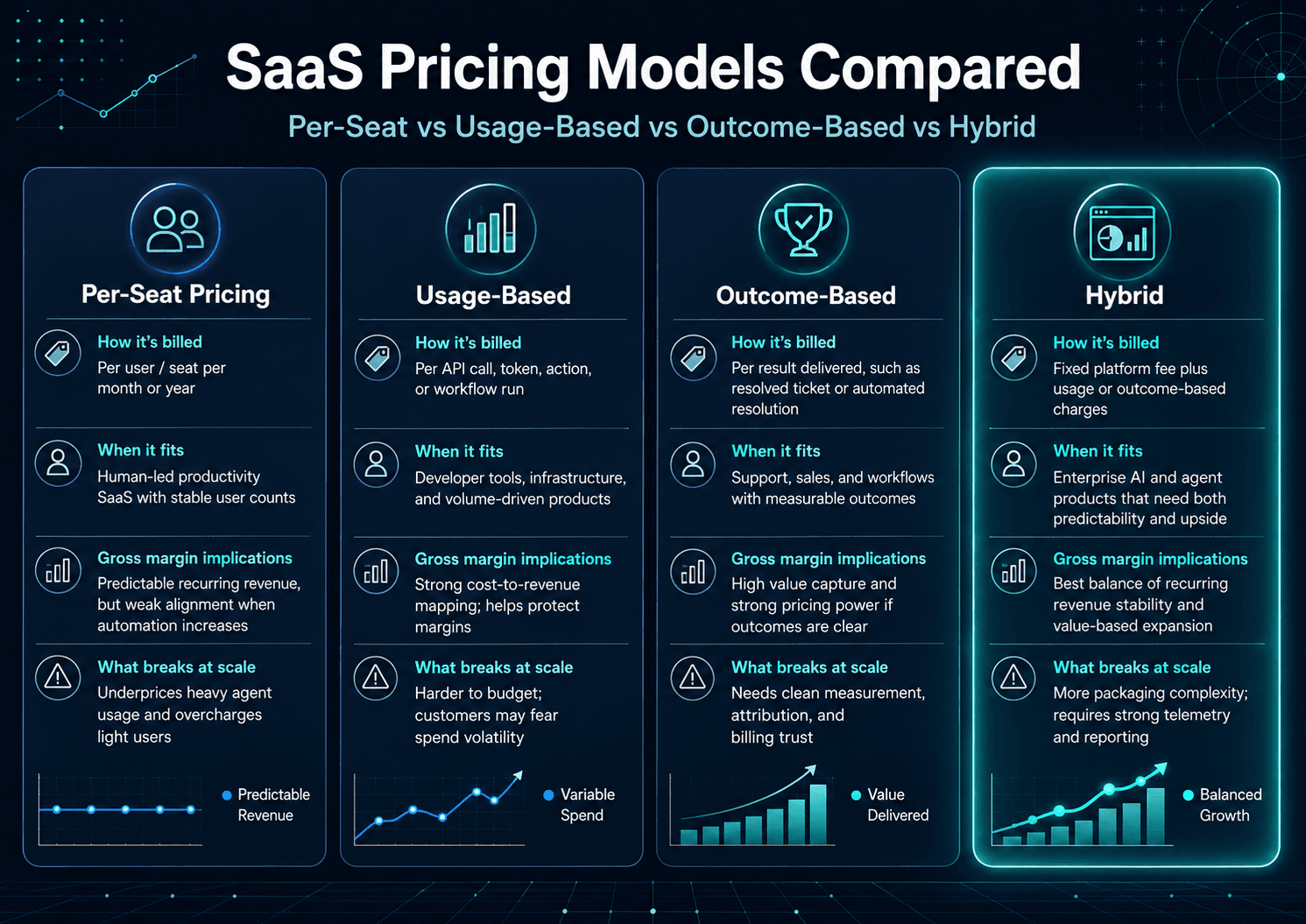
Three modes are live in the market right now:
Per API call, per token, per action. Predictable cost-to-revenue mapping, hard for procurement to budget. Best fit: developer tools and infrastructure SaaS where customers already think in volumes.
Per result delivered. Zendesk's Automated Resolution model is the cleanest live example. Best fit: support, sales, and anywhere the outcome is unambiguous enough to bill cleanly.
Fixed platform fee plus variable consumption or outcomes. Futurum's 2026 survey shows 43% of buyers prefer consumption-based and 27% prefer outcome-based — and most want a fixed floor.
This is no longer theoretical. The category leaders have published price cards:
The pattern: the floor is a platform fee procurement can plan; the ceiling is consumption or outcomes that scale with delivered value. The highest-valued SaaS companies in 2026 share three properties — real agent capability, consumption or outcome pricing, and NRR above 110%.
Before any team rewrites their price card, walk through these honestly:
Most teams blow up renewals because they try to flip the whole book at once. Don't.
Days 1–30: Instrument. Before changing a price, get clean telemetry on the unit of value you plan to bill on. If you can't measure it today, you can't bill on it in 90 days.
Days 31–60: Pilot a usage rider on new logos. Sell new customers a fixed platform fee plus a metered consumption rider. Watch deal velocity and the procurement conversation. Don't touch existing renewals yet.
Days 61–90: Migrate renewals selectively. Start with customers materially over-consuming on per-seat and ones who explicitly asked for usage-aligned pricing. Leave the rest for one more cycle.
Two mistakes to avoid: leading with outcome pricing before you can measure the outcome, and waiting one more cycle while competitors quietly repackage around you.
Build a SaaS pricing model that scales with usage and outcomes.
Continue exploring these related topics
TypeSafe AI's Jev returns typed decisions in 0.4s at $0.0004 per case, matching GPT-5.6 Terra's 67.9% at 1/76th the cost. Where it fits, and where it doesn't
GPT-6 Astra scores 72.6% on OSWorld 2.0 and costs $10/$50 per million tokens. Here's what OpenAI's AGI-era model actually changes, and what it doesn't.
Ox Alpha appeared free on OpenRouter with a 1M-token window and 16 trillion tokens processed in three days. Nobody has confirmed who built it.