

Product
Industry News
NVIDIA RTX Spark for AI Teams: Worth It ?
NVIDIA's RTX Spark laptop runs 120B-parameter LLMs locally with 128GB unified memory. Specs, the DGX Spark mix-up, and whether your AI team should buy.
•11 min read
Nvidia's Jetson edge-AI modules reach the lunar surface and orbit in 2026, likely the first GPU on the Moon. Here's why on-site AI beats beaming data home.
Working on this in your product? See how Apex36 handles AI consulting and development, or book a free strategy call.
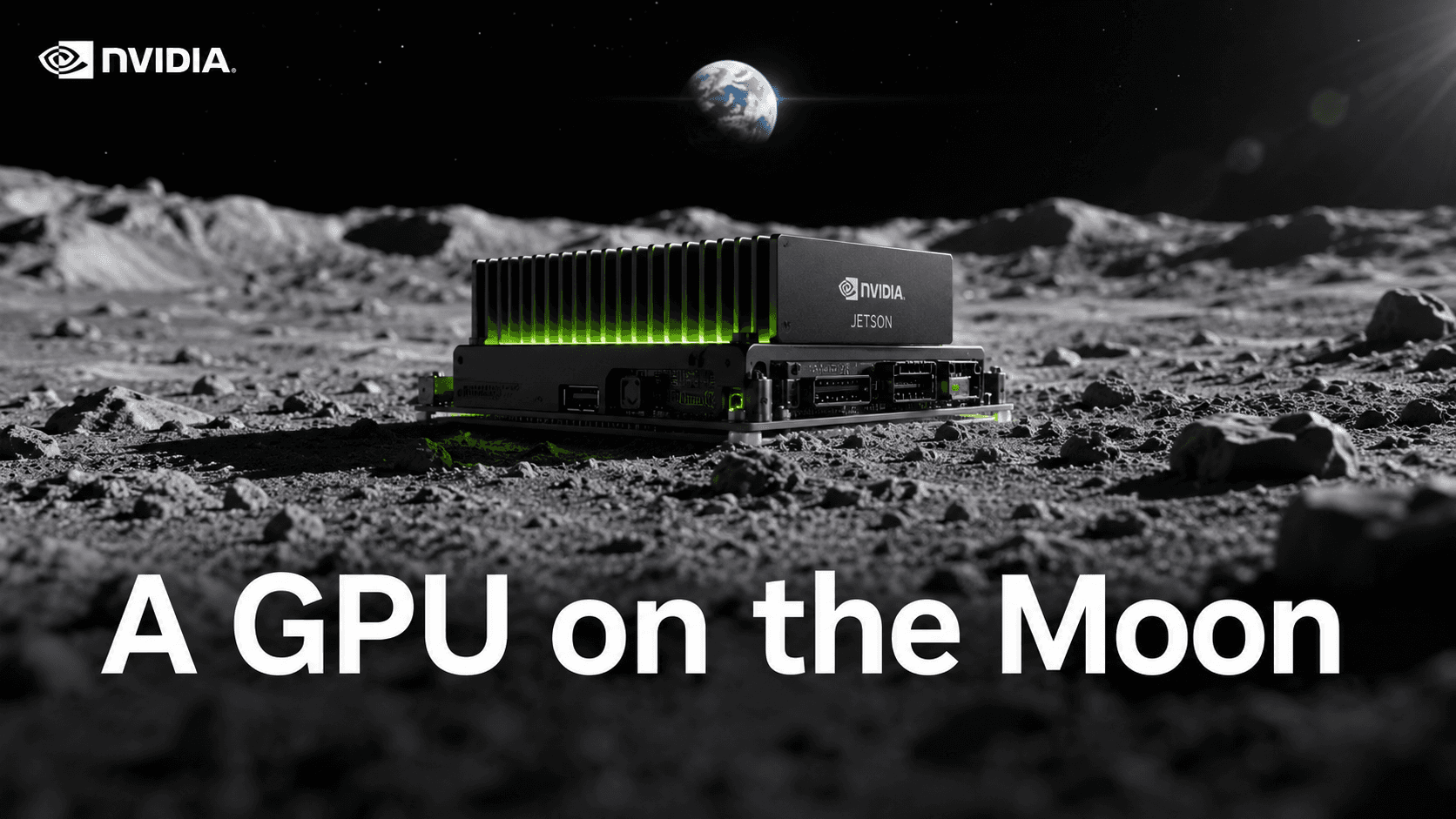
The headline sounds like a stock-market joke. It isn't. In July 2026, TechCrunch reported that Nvidia's Jetson chips will run the lidar on Lunar Outpost's next Moon rover, likely making it the first GPU ever to operate on the lunar surface. A second Jetson is already circling the Moon on a Firefly Aerospace satellite. So no, the chips aren't going up for a photo op. They're going up to think.
Key Takeaways
- Nvidia Jetson edge-AI modules are heading to both the lunar surface (Lunar Outpost's rover) and lunar orbit (Firefly's satellite) in 2026, likely the first GPU on the Moon (TechCrunch, July 2026).
- These are not the 700W data-center GPUs. A Jetson Orin module runs on 7W to 60W and fits in your palm (Nvidia, Jetson Orin specs).
- The point is on-site inference. Firefly's earlier mission downlinked nearly 120 GB of raw data that took weeks to process on Earth (Nvidia, July 2026).
- The chips have to survive lunar night, radiation, and extreme cold on minimal power, the harshest test edge AI has faced.
- This is a trend, not a stunt: Lunar Outpost has ten contracted lunar and cislunar missions before 2030.

Not what the headline implies. The chips going up are Nvidia Jetson modules, the company's small edge-AI computers, not the giant Blackwell GPUs that power data centers (TechCrunch, July 23, 2026). On Lunar Outpost's rover, a Jetson will command and control the lidar system, then handle post-processing and file compression before anything gets beamed home.
Lidar is the reason a GPU makes sense out there. It fires laser pulses to build a detailed 3D map of the terrain, which lets a rover pick its way across craters and boulders without a human steering it. That's a lot of sensor data to crunch in real time, exactly the kind of parallel workload a small GPU eats for breakfast. The rover, Lunar Voyage 2, is slated to explore Reiner Gamma, a strange magnetic anomaly on the Moon's surface, later in 2026.
There's a second Jetson already in the game, and it's arguably the bigger deal. Firefly Aerospace put a Jetson module on its Elytra spacecraft to power a lunar imaging service called Ocula, marking the first time Nvidia's edge AI platform has run in lunar orbit (Nvidia, "Firefly Aerospace Operates NVIDIA Jetson in Lunar Orbit", July 2026). Surface and orbit, same chip family, same year.

Because the Moon is very far away and the pipe home is thin. Firefly's first Blue Ghost mission, back in March 2025, sent nearly 120 GB of raw data back to Earth, and processing it took weeks to months (Nvidia, July 2026). When your bandwidth is scarce and your round-trip delay is measured in seconds, shipping every raw byte home is a terrible plan.
On-site inference flips the model. Instead of downlinking everything and analyzing it later, the Jetson runs the AI right there, extracts the useful findings, and transmits only what matters. Firefly's CEO, Jason Kim, framed the orbital version bluntly: "We're going to be able to do that for the first time in history" (Nvidia, July 2026). The Ocula service uses that on-orbit brain to map landing sites, spot minerals like ilmenite, and track objects in cislunar space.
For the rover, the payoff is autonomy. A vehicle that waits for Earth to approve every move barely moves at all. One that processes its own lidar can drive itself around a boulder in real time. Here's the thing worth sitting with: the value isn't a faster chip, it's a chip in the right place. Compute at the edge, where the data is born, is the entire pitch.
Notice what these chips are, though. A Jetson is a commercial, off-the-shelf module you can buy for a robotics project. Nvidia and its partners are betting that consumer-grade edge silicon, hardened and shielded, can do a job that used to demand bespoke, radiation-proof space computers. That's the real story hiding under the "GPUs to the moon" headline. It's less about the Moon and more about how cheap, capable AI hardware has gotten.
That's the open question, and everyone involved knows it. The Moon offers cosmic radiation, temperature swings of hundreds of degrees, and a two-week lunar night with almost no power to spare. Lunar Outpost CEO Justin Cyrus put the bar plainly: "Your system has to survive lunar night and has to do so on very low power" (TechCrunch, July 23, 2026).
Low power is where Jetson genuinely fits. These modules draw between 7W and 60W depending on the model, a rounding error next to the 700W a flagship data-center GPU like the H100 pulls (Nvidia, Jetson Orin specs). On a rover or a small satellite running off solar and batteries, that gap is the difference between possible and impossible.
Lunar Outpost isn't betting the mission on faith, either. Cyrus said the team is running the Jetson alongside a flight-proven compute platform with more spaceflight heritage, weighing the pros and cons before leaning fully on GPU-powered systems in extreme environments (TechCrunch, July 23, 2026). Sensible. You don't stake a Moon shot on a chip's first field trip.
It's the start of something, and the roadmap says so. Lunar Outpost describes ten fully contracted lunar and cislunar missions launching before 2030, and its Pegasus Lunar Terrain Vehicle is being built under a NASA contract to eventually carry astronauts (Manila Times / GlobeNewswire, July 23, 2026). One of those later missions aims for the first human-robot interaction on another world. This is infrastructure, not a demo.
Nvidia is building for it, too. Firefly's Elytra will orbit the Moon for a five-year mission, and Nvidia has already teased a space-specific successor, the Space-1 Vera Rubin Module, for future upgrades (Nvidia, July 2026). Analysts read the moment the same way: putting a commercial Jetson in lunar orbit signals that off-the-shelf GPUs are, finally, ready for spaceflight (Futurum Group, 2026).
When we help a client at Apex36 decide where AI should run, the Moon is an extreme version of a question we ask constantly: process here, or ship the data somewhere else first? The trade is always bandwidth, latency, power, and cost. A lunar rover just makes the answer obvious, because the "ship it home" option barely exists. Most edge cases on Earth are quieter versions of the same math, and teams get them wrong by defaulting to the cloud out of habit.
"Nvidia is sending GPUs to the Moon" is a great headline that undersells the actual idea. The chips are tiny, cheap-by-comparison edge modules, and the reason they're going is the same reason edge AI matters anywhere: when you can't afford to move the data, you move the computer to the data. The Moon is just the most dramatic place anyone has made that call.
If these Jetsons survive lunar night and keep working, the message travels well past space. It says commercial AI hardware is tough and efficient enough for the worst environment we can throw at it, which makes the everyday edge cases on Earth look a lot more approachable. The stock isn't the thing going to the Moon. The compute model is.
We'll talk it through against your real workloads, no pitch.
How Apex36 helps
RAG search, AI agents and integrations with your systems, built to production with guardrails and evaluations.
Case study: Pharma Enterprise Customer (HealthTech · Pharma)
Continue exploring these related topics
NVIDIA's RTX Spark laptop runs 120B-parameter LLMs locally with 128GB unified memory. Specs, the DGX Spark mix-up, and whether your AI team should buy.

Cursor's Origin launched in beta on August 17, 2026, the same day GitHub went down for 7.5 hours. Here's what it actually ships, and what it still can't do.

Smart AI glasses shipments hit 13.6 million units in 2026, led by Meta's Ray-Bans. Here's what's fueling the boom, and the privacy backlash trailing it.