

Industry News
Product
Why Is Nvidia Sending GPUs to the Moon?
Nvidia's Jetson edge-AI modules reach the lunar surface and orbit in 2026, likely the first GPU on the Moon. Here's why on-site AI beats beaming data home.
•7 min read
NVIDIA's RTX Spark laptop runs 120B-parameter LLMs locally with 128GB unified memory. Specs, the DGX Spark mix-up, and whether your AI team should buy.
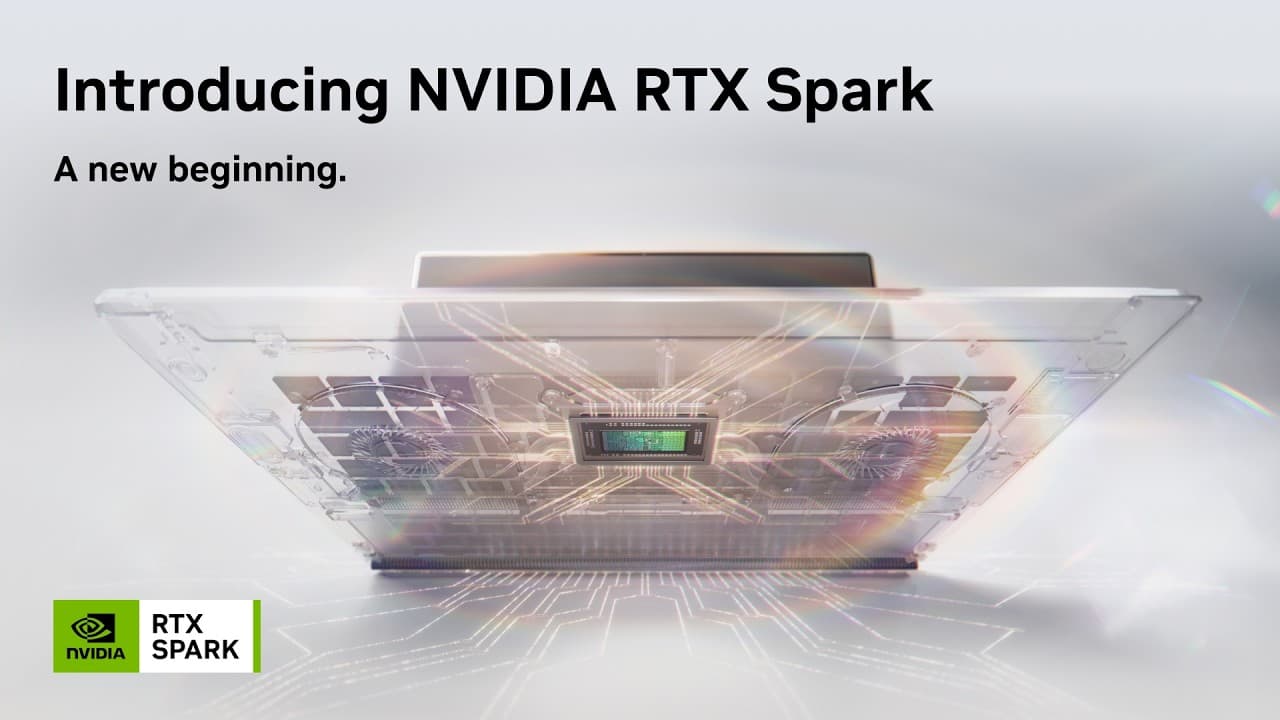
On June 1, 2026, NVIDIA used its Computex keynote to announce the RTX Spark Superchip: a laptop platform built jointly with Microsoft to run a 120-billion-parameter language model on your lap, with no cloud round-trip (NVIDIA, "NVIDIA and Microsoft Reinvent Windows PCs for the Age of Personal AI", June 2026). That's a machine that, on paper, does locally what most teams rent an H100 for. So the real question for anyone building AI products isn't "is it fast?" It's "does owning one change how my team works, or is it a beautifully engineered distraction?" Here's the honest breakdown.
Key Takeaways
- RTX Spark laptop price: NVIDIA hasn't officially disclosed pricing as of June 2026, but based on the related DGX Spark (~$3,999–$4,699), expect RTX Spark laptops to start in the premium ~$3,000–$5,000+ tier when they ship fall 2026 (see price section below).
- RTX Spark pairs a 20-core Grace CPU with a 6,144-core Blackwell GPU and up to 128GB of unified memory, delivering 1 petaflop of FP4 AI performance (NVIDIA RTX Spark product page, 2026).
- It can run 120B-parameter LLMs with a 1-million-token context window locally — a workload that normally requires cloud GPUs.
- Don't confuse it with the DGX Spark, the ~$4,699 desktop dev box; RTX Spark is the consumer Windows laptop/desktop line shipping fall 2026.
- The AI inference market is heading from $106B in 2025 to $255B by 2030, and edge/on-device is taking a growing share — which is the strategic backdrop here (MarketsandMarkets, 2026).
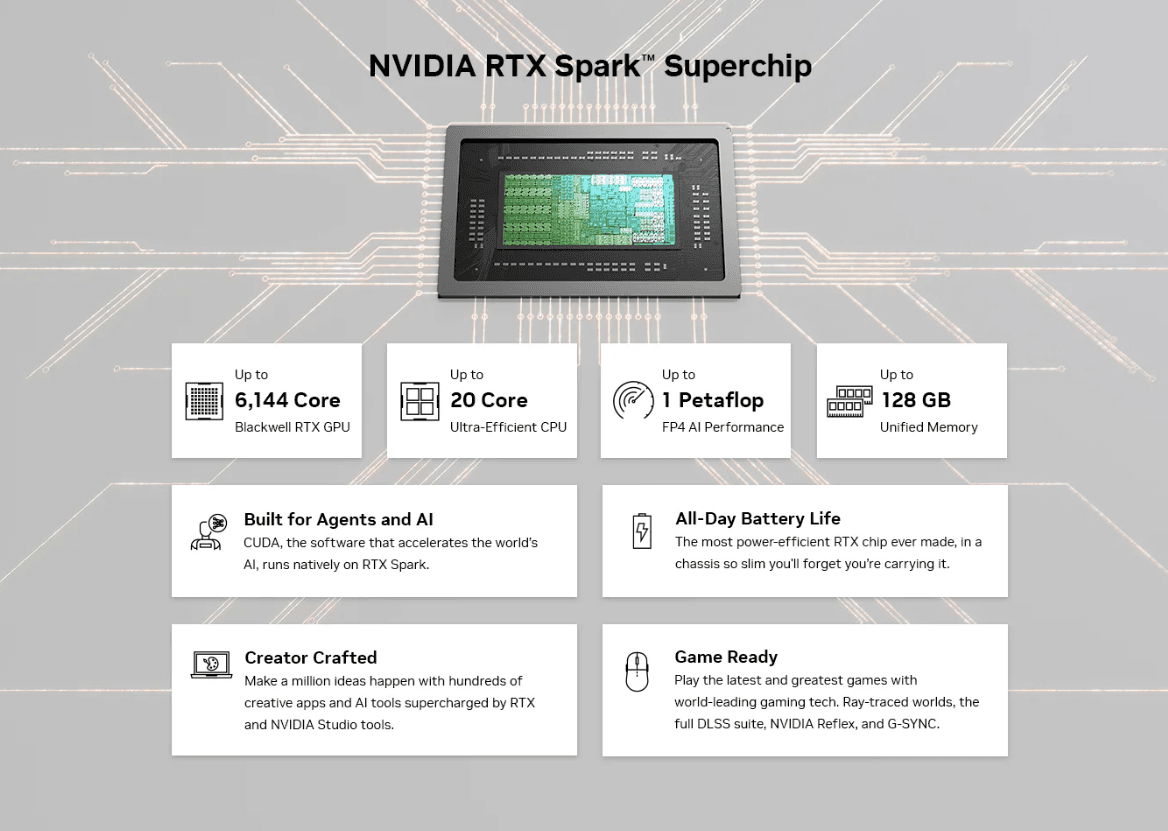
In 2026, NVIDIA defined RTX Spark as a Windows PC platform delivering 1 petaflop of AI performance with up to 128GB of unified memory (NVIDIA RTX Spark product page, 2026). It's a single Arm-based superchip, not a discrete CPU plus a separate GPU, purpose-built so AI agents can run on-device rather than in a data center.
The silicon is a tight package. RTX Spark combines a 20-core NVIDIA Grace CPU (co-designed with MediaTek for power efficiency) and a Blackwell RTX GPU with 6,144 CUDA cores and fifth-generation Tensor cores supporting FP4 precision, linked by NVIDIA's NVLink-C2C interconnect. Memory bandwidth reaches up to 300 GB/s across that shared 128GB pool.
What does that buy you in practice? NVIDIA's own claims are specific: run 120B-parameter models with up to a 1-million-token context, render 90GB-plus 3D scenes, edit 12K 4:2:2 video, generate 4K AI video, and still play AAA games at 1440p above 100 fps. Adobe says Photoshop and Premiere run AI and graphics tasks up to 2x faster on the platform.
According to NVIDIA's June 2026 announcement, RTX Spark delivers 1 petaflop of FP4 AI compute and up to 128GB of unified memory, enough to run a 120-billion-parameter LLM with a 1-million-token context entirely on-device (NVIDIA RTX Spark product page, 2026). For AI teams, that single spec, 128GB of memory the GPU can address directly, is the headline, not the gaming numbers.
The laptops themselves are thin-and-light, not desktop replacements: 14-to-16-inch chassis as thin as 14mm and as light as 3 pounds, with tandem OLED G-Sync displays and all-day battery life.
As of June 2026, NVIDIA has not officially disclosed RTX Spark laptop pricing — you can only register for availability notifications on the RTX Spark product page ahead of the fall 2026 launch. But you don't have to guess blind. The closely related DGX Spark desktop, which shares the same Grace Blackwell architecture and 128GB unified memory, launched at roughly $3,999–$4,699 (Tom's Hardware, "NVIDIA DGX Spark review", 2026). That gives us a grounded basis for what to expect.
Short answer: Expect RTX Spark laptops to launch in the premium ~$3,000–$5,000+ price tier in fall 2026. Entry configurations (lower memory) may dip toward $3,000, while flagship 128GB models from premium OEMs (Surface Laptop Ultra, Dell XPS 16, ASUS ProArt) will likely sit at $4,500 and up. These are informed estimates based on the DGX Spark's pricing and the creator/pro branding — not confirmed figures.
Here's how the expected pricing breaks down by configuration. Treat every number below as an estimate until NVIDIA and its OEM partners publish official MSRPs:
| RTX Spark configuration | Expected price range (estimate) | Likely buyer |
|---|---|---|
| Entry laptop (reduced memory) | ~$3,000–$3,500 | Developers, prosumers |
| Mid-tier 128GB laptop | ~$3,800–$4,500 | Creators, agentic-AI users |
| Flagship 128GB (premium OEM) | ~$4,500–$5,500+ | Studios, AI teams |
| RTX Spark mini desktop | ~$3,500–$4,700 | Desk-bound local AI |
Estimates derived from DGX Spark pricing (~$3,999–$4,699) and premium OEM branding. NVIDIA had not disclosed official RTX Spark prices as of June 2026.
RTX Spark laptop price in India: with no official India MSRP yet, a ~$4,000 US price typically translates to roughly ₹3.4–3.6 lakh before taxes, and import duties plus GST commonly push imported premium laptops to ₹4.5 lakh and above. Watch for India availability and pricing alongside the fall 2026 global launch. Again, these are conversion-based estimates, not announced figures.
The honest bottom line on price: if a sub-$3,000 RTX Spark laptop is what you're hoping for, temper expectations. This is positioned as a premium AI workstation-class platform, and the unified-memory silicon that makes it special is expensive. Budget for a flagship-tier purchase and wait for official pricing at the fall reviews before committing.
Here's the trap that's already tripping up buyers: NVIDIA now sells two different "Spark" machines, and in 2026 they share a chip family but serve opposite users (Tom's Hardware, "NVIDIA DGX Spark review", 2026). One is a laptop you'll buy at retail this fall. The other is a $4,699 desktop dev box that's already shipping.
The naming overlap is not accidental, and it's worth understanding before you spec a purchase order. Both are Grace Blackwell designs with 128GB of unified memory and roughly 1 petaFLOP of FP4 performance. But the DGX Spark is a 1.1-liter desktop AI developer kit built on the GB10 SoC, aimed at researchers who want CUDA and unified memory on their desk for prototyping before they push to a cluster. The RTX Spark is a consumer Windows platform, spanning laptops and small desktops, aimed at creators, gamers, and agentic-AI users. If a vendor or article just says "Spark," ask which one.
In 2026, NVIDIA's DGX Spark shipped at roughly $4,699 as a 128GB GB10 desktop that one review called "a well-rounded toolkit for local AI" that nonetheless "is not the fastest or most cost-effective choice for brute-force inference" (Tom's Hardware, "NVIDIA DGX Spark review", 2026). The same caveat applies to the RTX Spark laptop: it's a development and agent-hosting machine first, an inference appliance second.
| RTX Spark (laptop/desktop) | DGX Spark (dev box) | |
|---|---|---|
| Form factor | 14–16" laptops + mini desktops | 1.1L desktop |
| Chip | Grace CPU + Blackwell RTX | GB10 Superchip |
| Unified memory | Up to 128GB | 128GB LPDDR5X |
| AI performance | ~1 petaflop FP4 | ~1 petaFLOP FP4 |
| Primary user | Creators, agentic-AI, gamers | AI researchers/developers |
| Availability | Fall 2026 | Shipping now |
| Price | Not yet disclosed | ~$3,999–$4,699 |
Sources: NVIDIA RTX Spark product page (2026); Tom's Hardware DGX Spark review (2026).
Yes, and the reason is the 128GB of unified memory, not raw compute. In 2026, the bottleneck for local LLM inference is almost always memory capacity, not FLOPS: a 120B-parameter model quantized to 4-bit needs roughly 60–70GB just to hold weights, which is far beyond the 16–24GB of VRAM on a typical high-end gaming laptop. RTX Spark's shared pool removes that wall.
Unified memory matters because the CPU and GPU address the same physical RAM, so there's no copying a model across a narrow PCIe bus. That's the same architectural trick Apple's M-series and NVIDIA's DGX Spark use, and it's why a 1-petaflop laptop can hold a model that a much faster discrete GPU with 24GB simply cannot load.
A 120-billion-parameter model in 4-bit precision needs roughly 60–70GB of memory just for weights, which is why RTX Spark's 128GB unified pool, not its petaflop rating, is what makes local execution possible (NVIDIA RTX Spark product page, 2026). Teams evaluating local inference should size the machine by memory headroom first and throughput second.
The caveat: "can run" is not "runs fast." A 128GB unified laptop will load a 120B model that a cloud H100 cluster serves far faster. For interactive development and single-user agents, that trade is fine. For serving production traffic, it isn't. That's the next question.
Sometimes. In 2026, on-prem and on-device hardware wins decisively for steady, always-on, or privacy-bound workloads, while the cloud still wins for bursty or short-lived ones (SitePoint, "Local LLMs vs Cloud APIs: 2026 Total Cost of Ownership Analysis", 2026). The momentum is real: 97% of US CIOs put edge AI in their 2025–2026 roadmaps, and over half of new enterprise computer-vision deployments now run on edge devices, up from about 30% in 2023 (Datature, "Enterprise Vision AI Adoption Report 2026", 2026).
The cost math is the part teams get wrong. Cloud H100 rental in mid-2026 spans a huge range, from about $1.03/hour on spot capacity to $12.29/hour on hyperscalers, so "the cloud is cheap" depends entirely on which door you walked through (IntuitionLabs, "H100 Rental Prices Compared", 2026).
A useful rule of thumb from 2026 cost analyses: if you're spending more than ~$150/month on cloud GPU time for a single developer, a local machine usually pays for itself within a year (SitePoint, 2026). For a team of engineers each burning cloud credits on experiments, an RTX Spark laptop per developer can pencil out fast — especially when the data can't leave the building.
In 2026, organizations running inference at the edge reported 30–40% energy-cost savings and sub-10ms latency versus cloud round-trips, while 72% of enterprises had at least one AI workload in production (Datature, "Enterprise Vision AI Adoption Report 2026", 2026). For regulated industries, the privacy of keeping data on-device is often worth more than the raw economics.
This is the strategic backdrop: inference is the spending center of gravity now, and it's growing fast.
Six major OEMs are launching RTX Spark laptops first, with two more to follow, all in fall 2026 (NVIDIA newsroom, June 2026). NVIDIA says more than 30 laptop designs and 10 desktop configurations are planned, so this isn't a niche launch — it's a platform bet.
The confirmed first wave: the ASUS ProArt P16, Dell XPS 16, HP OmniBook X 14, Lenovo Yoga Pro 9n, Microsoft Surface Laptop Ultra, and MSI Prestige N16 Flip AI+, with Acer and GIGABYTE models coming later. The creator-and-pro branding (ProArt, XPS, Surface Ultra) tells you who NVIDIA thinks the early buyer is.
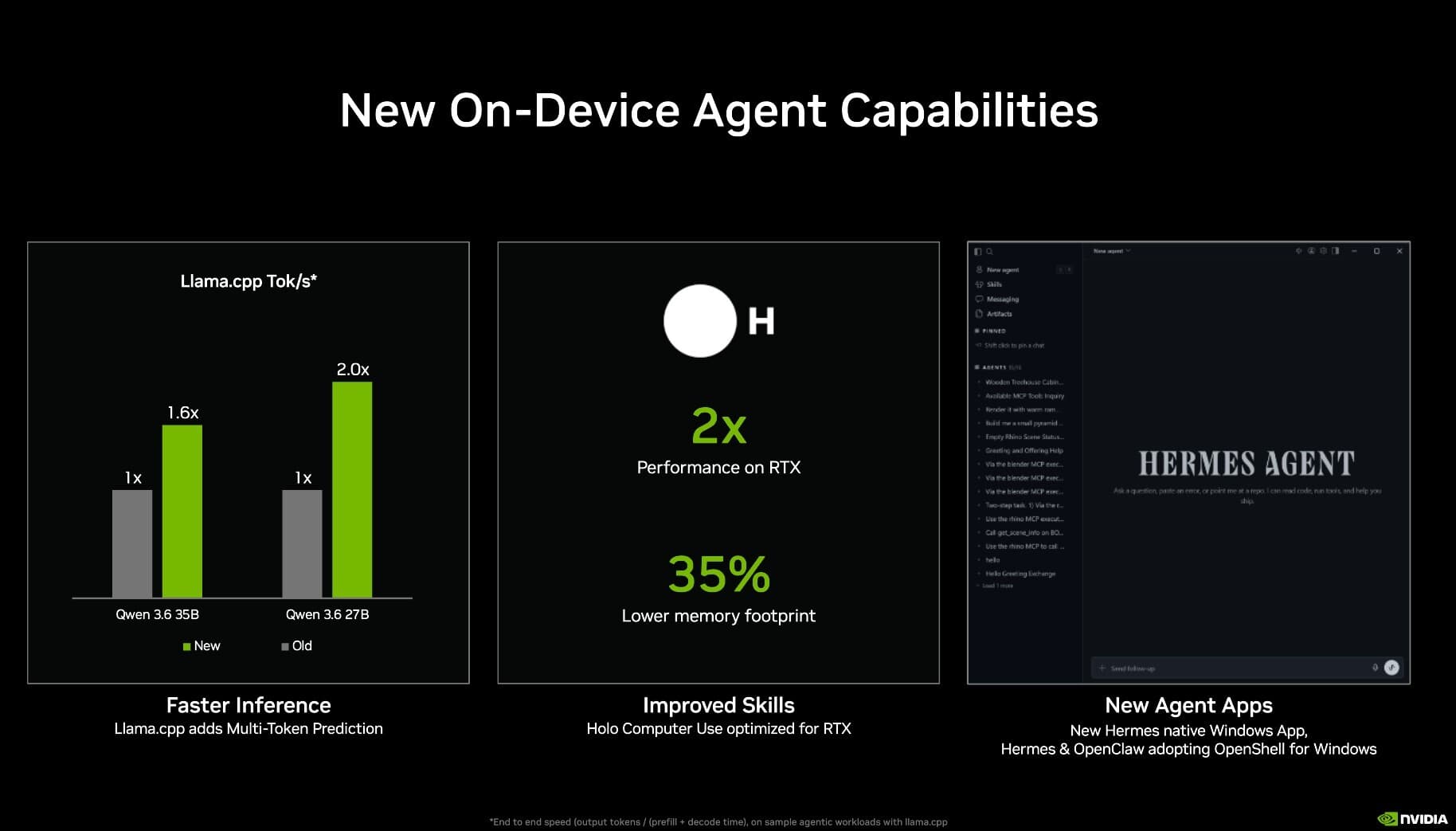
There's a second half to the announcement that matters for the agentic crowd. RTX Spark ships alongside new Windows security primitives, an NVIDIA OpenShell runtime for policy control, and query routing that masks personal information before anything goes to the cloud — plus native Windows agent execution for frameworks like OpenClaw and Hermes Agent. The pitch is a laptop where agents run real tasks under OS-level guardrails. For teams worried about what agents can touch, that containment story is as important as the silicon, and it deserves its own AI agent security checklist.
Should you wait? Almost certainly yes, for now. Pricing is undisclosed, independent benchmarks don't exist yet, and first-generation platforms carry driver-and-software risk. The smart move in mid-2026 is to spec your workload, watch the fall launch reviews, and pilot one or two units before fleet-buying. Treat the announcement as a planning signal, not a purchase order.
The RTX Spark laptop is the clearest sign yet that serious AI work is moving onto the device. The headline isn't the petaflop. It's the 128GB of unified memory that lets a thin-and-light laptop hold a 120B-parameter model that a faster discrete GPU can't even load.
For AI teams, the verdict in mid-2026 is "watch closely, pilot before you scale." The economics favor local hardware for steady or privacy-bound workloads, the agent-containment story is compelling, and the OEM lineup is broad. But with no pricing, no independent benchmarks, and first-gen risk, the disciplined move is to size your workload now and let the fall reviews land.
Our AI development experts build intelligent AI agents, chatbots, and automation solutions tailored to your business needs.
Continue exploring these related topics
Nvidia's Jetson edge-AI modules reach the lunar surface and orbit in 2026, likely the first GPU on the Moon. Here's why on-site AI beats beaming data home.

Cursor's Origin launched in beta on August 17, 2026, the same day GitHub went down for 7.5 hours. Here's what it actually ships, and what it still can't do.

Smart AI glasses shipments hit 13.6 million units in 2026, led by Meta's Ray-Bans. Here's what's fueling the boom, and the privacy backlash trailing it.