Automotive
Automotive software development and automotive AI
By Yash Soni, Founder & CEO, Apex36Updated
In short
Apex36 builds automotive software for the business side of the industry: procurement and supplier data, ERP-adjacent automation, and dealer and service tools, with automotive AI where reading documents slows people down. For a US enterprise automaker, we built serverless AWS automations that prepare and validate data before SAP and Coupa ingestion. A first automated workflow starts from $5,000.
Key facts
| Starting price | First workflow from $5,000; AI development from $8,000 |
|---|---|
| Typical first milestone | Assessment report by email within 48 hours; first workflow typically live in 2 to 4 weeks |
| Engagement model | Fixed-price first workflow, then optional monthly support or a monthly team |
| Markets | US, UK, Australia, Singapore, UAE |
| Built for | The access and change controls your IT and procurement teams set; GDPR for UK and EU data |
Automotive software development for the business side
Automotive software usually means code in the car. That is not what we build. We do not build in-vehicle or embedded software. We build the software that runs the company around the car: purchasing, supplier data, ERP feeds, dealer operations and service workflows. That is where manual work piles up, and where a small team can ship a change in weeks instead of a model year.
Automotive procurement automation
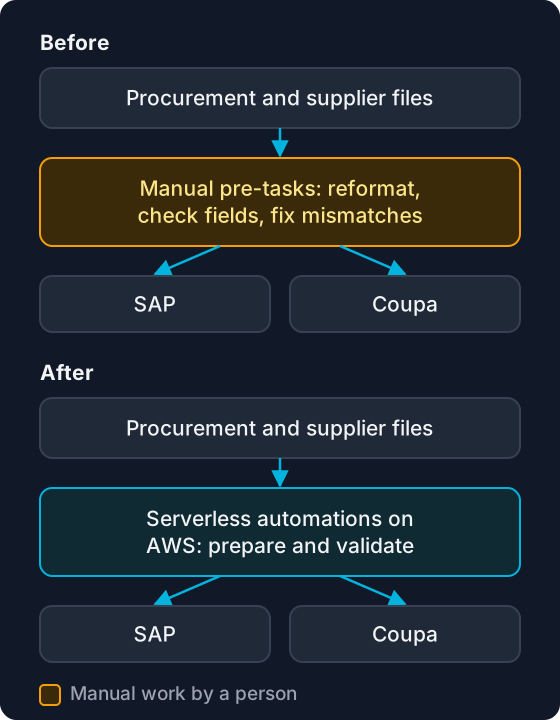
Automotive procurement moves large volumes of supplier, part and pricing data into ERP and purchasing systems. Before it can be loaded, someone often has to reformat files, check fields and fix mismatches by hand. Those pre-tasks become the bottleneck and the main source of errors.
For a US enterprise automaker, we built serverless automations and data pipelines on AWS that sit in front of SAP and Coupa and take over that preparation and validation work, so data reaches the ERP and procurement systems without the manual pre-tasks. The engagement ran for two months, July to August 2026, and was part of a company-wide programme targeting USD 50M a year in savings. That figure is the client's programme target, not a result we claim.
Automotive AI: where it helps outside the vehicle
Automotive AI is not only driver assistance. On the business side, its most practical use is reading: supplier quotes and contracts, invoices, warranty claims, service notes and parts catalogues. A model can extract the fields that matter, classify a warranty claim, compare a quote against agreed prices or summarise a repair history for a service advisor. We pair it with rules for anything fixed, such as approval limits and part number formats, and send uncertain cases to a person. Models run in your own cloud account.
Automotive software solutions for dealers and service teams
How we would build it. Dealer groups and service networks run on a dealer management system plus a layer of spreadsheets and email. We would start with one workflow from that layer: routing online leads to the right branch, preparing warranty claims with the documents the manufacturer asks for, or turning service notes into a clear summary for the customer. Each tool connects to your dealer management system through its API or exports and leaves it unchanged.
Asset-management platform for an Australian vehicle auction company
Apex36 worked in a ten-person team on the platform: CQRS microservices with a Next.js app and Angular micro-frontends, on MSSQL, GraphQL and Kafka in Azure. The platform is live in production.
Working with an automotive software development company
Enterprise automotive teams need a vendor that fits their security and change processes. We work inside your cloud account, follow your access rules and review steps, and keep changes small and reversible. You see a demo and a written changelog every week, and at handover you get a runbook your team can operate. For the automaker engagement this meant delivering the automations in two months alongside its existing systems.
What automotive software costs
A first automated workflow, such as data preparation and validation ahead of one ERP feed, starts from $5,000. Automotive AI work, such as document extraction or warranty claim classification, starts from $8,000. More systems, higher volumes and enterprise review steps move the price up. Cloud and model costs are billed to your own accounts. See pricing.
How we would build it: dealer and service tools
- First workflow
- lead routing, warranty claim preparation or service summaries, chosen in the free assessment.
- Where it runs
- your own cloud account, connected to your dealer management system.
- What you see
- a review queue for uncertain cases, a log of every action and a weekly demo.
- What you own
- the code, the runbook and the cloud resources.
Proof from our work
Frequently asked questions
Beyond driver assistance, automotive AI reads and sorts business documents: supplier quotes, invoices, warranty claims, service notes and parts data. It extracts fields, classifies claims and summarises histories, with a person reviewing uncertain cases.
No. We build the business software around the vehicle: procurement and supplier data, ERP-adjacent automation, and dealer and service tools.
Yes. For a US enterprise automaker, we built serverless AWS automations that prepare and validate data before SAP and Coupa ingestion, removing the manual pre-tasks.
At Apex36, a first automated workflow starts from $5,000, and automotive AI work from $8,000. Systems, volumes and enterprise review steps add to that. You get a fixed quote in writing after a free assessment.
No. USD 50M a year is the target of the client's company-wide automation programme. Our work was one part of that programme, and we do not claim a savings figure for it.
Yes. We would start with one workflow, such as lead routing, warranty claim preparation or service summaries, and connect it to your dealer management system without changing it.
A first workflow is typically live in 2 to 4 weeks. Our procurement automation for a US automaker was delivered in two months, July to August 2026.
Services for this industry: Workflow automation · AI consulting and development · DevOps and cloud consulting
Find out what to build first
Start with the free AI readiness assessment and get a written report by email, or book a 30-minute strategy call with the founder.