Banking & Financial Services
Fintech software development and finance automation
By Yash Soni, Founder & CEO, Apex36Updated
In short
Apex36 is a fintech software development company for banks, lenders, fintech startups and in-house finance teams. We build finance automation such as accounts payable workflows and reconciliation, banking and fintech apps, and private AI for sensitive financial data, built for PCI DSS, GLBA and FCA-regulated workflows. A first automated workflow starts from $5,000.
Our financial services work so far includes a car-lease platform for an Australian fleet-leasing company. For banking and fintech builds, this page explains what we build and how we would build it.
Key facts
| Starting price | First workflow or MVP from $5,000; AI development from $8,000 |
|---|---|
| Typical first milestone | Assessment report by email within 48 hours; first workflow typically live in 2 to 4 weeks |
| Engagement model | Free AI readiness assessment, a fixed-price first workflow or MVP, then optional monthly support or a monthly team |
| Markets | US, UK, Australia, Singapore, UAE |
| Built for | PCI DSS, SOC 2 controls, GLBA (US), FCA rules (UK), GDPR |
Finance automation: what to automate first
Finance teams close the month on spreadsheets, inboxes and copy-paste. The best first candidates for finance automation have high volume, clear rules and a person who checks the result today: supplier invoices, bank reconciliation, expense checks and month-end reports. Credit decisions are better left as assisted work, where software prepares the case and a person decides.
Accounts payable automation
An accounts payable workflow we would build reads invoices from an inbox or upload, extracts supplier, amounts, tax and line items, and matches each invoice to its purchase order and goods receipt. Invoices that match within your tolerances are routed for approval; anything that fails a check goes to an AP reviewer with the reason shown. Approved invoices are posted to your ERP or accounting system, and every step is written to an append-only log your auditors can read.
The same kind of work, in automotive: for a US enterprise automaker, we built serverless AWS automations that prepare and validate procurement data before it reaches SAP and Coupa. Getting data clean before it enters the system of record is the core of AP automation too.
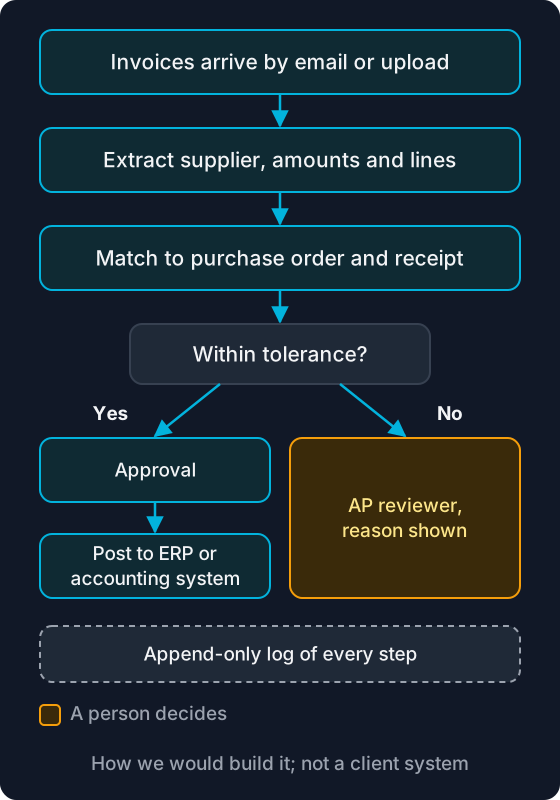
Fintech software development company: how we would build it
Without a fintech case study to show, here is the exact process you would get:
- Map: a free AI readiness assessment, with a written report by email within 48 hours, naming the workflow worth building first.
- Scope: a fixed quote in writing for one workflow or one MVP, with the controls your compliance team requires listed as acceptance criteria.
- Build: in your own cloud account, on your real data or a masked copy, with a review queue for uncertain cases and a log of every decision.
- Run: a demo and a written changelog every week, then a runbook your team can operate.
Banking software development
We do not replace a core banking system. We build the software around it: onboarding and KYC document handling, where uploaded IDs and statements are read, checked for missing pages and queued for an analyst; reconciliation tools that surface breaks between ledger and statements; and reports still assembled by hand each month, all connected through your core system's APIs or file exports.
Fintech app development
A fintech app MVP needs a few things a typical app does not: strong sign-in with multi-factor authentication, a ledger that never edits a past entry, payments through a card-processing provider so card numbers never touch your servers, and an audit log from the first release. We build that foundation first, then the features that make your product different. A fintech MVP starts from $5,000 for one core flow.
Financial software development for in-house finance teams
Many finance teams run critical processes on a spreadsheet only one person understands. We turn it into a web app with logins, roles, validation on every input and a history of every change, keeping the export your team relies on.
Car-lease platform redesign for an Australian fleet-leasing company
Apex36 worked in a four-person team on the redesign: a migration from .NET MVC to Next.js, with PostgreSQL on AWS. The platform is live in production.
AI for financial services: private models for sensitive data
AI in banking and finance is most useful for reading: extracting fields from statements and contracts, summarising a customer file for an analyst, or answering staff questions from your policies with the source quoted. Financial data rarely belongs on a public AI service. We run models inside your own cloud account, either through a private endpoint or as an open-weight model you host (see private LLM), test them on your own examples before launch, and send any answer the model is unsure of to a person.
Built for PCI DSS, SOC 2, GLBA and FCA-regulated workflows
We build to the controls your compliance team sets and document how each one is met:
- Card data kept out of your systems by a card-processing provider, to reduce PCI DSS scope
- Access limited by role, with multi-factor sign-in and access logs
- Append-only audit trails: a correction is a new record, never an edit
- Data kept in your cloud account and region, encrypted in transit and at rest
- Change history for every rule and model version, to support SOC 2 controls
GLBA (US), FCA rules (UK) and GDPR obligations stay with your organisation; we build the software so they are easier to meet and evidence.
What fintech software and finance automation cost
A first automated finance workflow starts from $5,000, covering one workflow from one source system to one destination, with a review queue and a log. A fintech app MVP also starts from $5,000, and AI development from $8,000. More systems, higher volumes and stricter audit needs move the price up. Model and cloud costs are billed to your own accounts. See pricing.
How we would build it
We follow the four steps under "Fintech software development company: how we would build it". Likely first workflows: accounts payable matching or bank reconciliation. You own the code, the runbook and the cloud resources.
Related work
Car-lease platform redesign for an Australian fleet-leasing company
A migration from .NET MVC to Next.js, with PostgreSQL on AWS, by a four-person team including Apex36. Live in production.
Automotive · Procurement
Procurement data automation for a US enterprise automaker
The same kind of work in another industry: serverless AWS automations that prepare and validate data before SAP and Coupa ingestion.
Read the case study
Frequently asked questions
At Apex36, a first automated workflow or a fintech MVP starts from $5,000, and AI development from $8,000. Integrations, volume and audit needs add to that. You get a fixed quote in writing after a free assessment.
Accounts payable automation uses software to read supplier invoices, extract the details, match them to purchase orders and receipts, route them for approval and post them to your accounting system. People handle only the invoices that fail a check.
Banks use AI mostly to read and sort: extracting data from documents during onboarding, summarising customer files, flagging unusual transactions for review and answering staff questions from internal policy. The safe pattern keeps data in the bank's own cloud and a person in charge of decisions.
Yes. Apex36 worked on the redesign of a car-lease platform for an Australian fleet-leasing company, now live in production. For banks, lenders and fintech startups, this page shows how we would build your workflow, and you get a fixed scope and price in writing before any build.
Yes. We run models inside your own cloud account, through a private endpoint or as an open-weight model you host, so documents never go to a public AI service.
We build to the controls your compliance team sets for PCI DSS and SOC 2: card data kept out of scope by a card-processing provider, role-based access, append-only logs and change history. Your organisation keeps the assessment and sign-off.
Yes. We connect through the system's API or file exports and automate the work around it rather than changing it. Our procurement automation for a US automaker fed SAP and Coupa this way.
A first workflow is typically live in 2 to 4 weeks, depending on data access and the systems it touches.
Services for this industry: Workflow automation · AI consulting and development · Private LLM · SaaS and MVP development
Find out what to build first
Start with the free AI readiness assessment and get a written report by email, or book a 30-minute strategy call with the founder.