

LLMs
AI Productivity
OpenAI Dots vs Meta Muse: Price, Safety and Fit (2026)
OpenAI Dots vs Meta Muse: Dots needs a $100 Pro plan, Muse starts free and hit 6.6M downloads. We compare models, cost, safety and which fits your team.
•15 min read
AI in banking, in practice: where it pays off first (onboarding documents, reconciliation, accounts payable, staff questions), where it should not decide alone, and how to start.
Working on this in your product? See how Apex36 handles Banking & Financial Services, or book a free strategy call.
AI in banking pays off first in the work people do by reading: onboarding documents, statements, invoices, customer files and internal policy. It pays off least when it is asked to make credit, fraud or complaint decisions on its own. This guide covers where to start, where to hold back, how to keep data inside the bank, and what a first project costs.
We have not published a banking case study. What follows is how we would build this work, based on the same patterns we use for document-heavy workflows in other regulated industries.
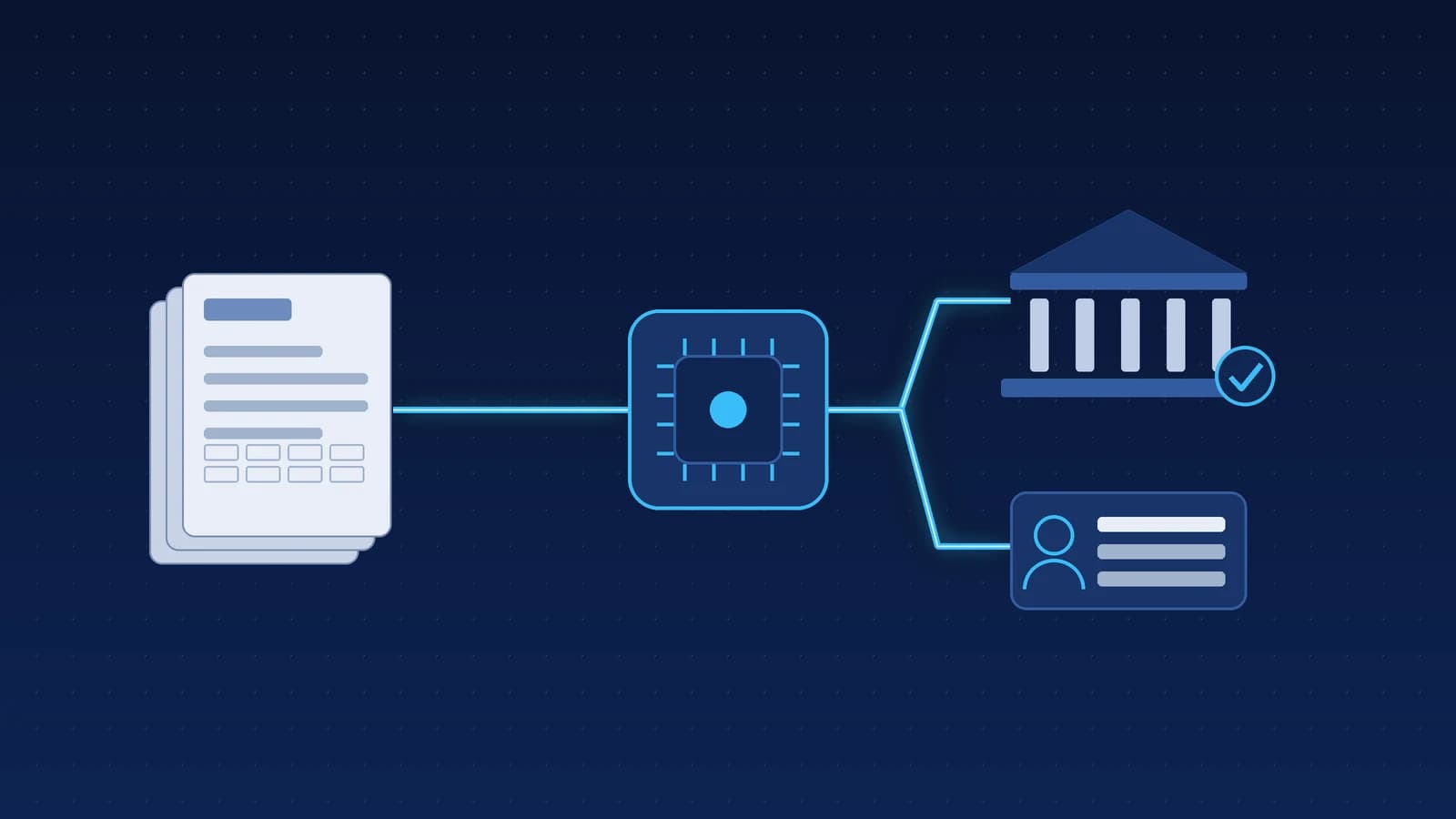
Most useful AI in banks today does three things: it reads, it sorts and it drafts. It reads a scanned ID, a bank statement or a loan agreement and pulls out the fields a person would type in. It sorts incoming work, such as emails, documents and alerts, into the right queue. It drafts a summary, a reply or a case note for a person to check.
None of that is autonomous decision-making. The bank still decides who gets an account, a loan or a refund. The software makes the people who decide faster and better informed, and it records what it suggested so the decision can be explained later.
The best first candidates share three traits:
Work that fits all three is where automation saves the most time with the least risk. Work that fails the second test, where every case is a judgement call, is better left as assisted work: software prepares the case, a person decides.
Onboarding is a document problem. Customers upload IDs, proof of address and statements, and an analyst checks each one. A first workflow we would build reads each upload, extracts the fields, checks for missing pages, expired documents and mismatched names, and puts the complete cases at the front of the analyst's queue with a summary. Incomplete cases trigger a request to the customer. Anything unusual goes to the analyst with the reason shown.
The analyst still approves the customer. What changes is that they spend their time on the cases that need judgement, not on retyping fields.
Banks also have back offices that run on spreadsheets. Two good first targets:
Both are rule-heavy, with AI needed only where documents must be read. For a US enterprise automaker (automotive, not banking), we built serverless AWS automations that prepare and validate procurement data before it reaches SAP and Coupa. Clean data before it enters the system of record is the core of AP automation too. See how we would build it on our financial services page.
Bank staff spend time searching policy documents, product terms and procedures. A retrieval-augmented assistant answers their questions from those documents and quotes the passage it used, so a person can check the answer before acting on it. When the documents do not answer the question, the assistant should say so instead of guessing.
This is an internal tool, for staff, with sources shown. It is a good first AI project because it touches no customer decisions and its answers are easy to verify.
Some decisions carry legal and customer consequences that a model should not carry alone:
In each case the system should log what the AI suggested and what the person decided. That record is what lets the bank explain a decision to a customer, an auditor or a regulator.
Financial data rarely belongs on a public AI service. The pattern we use is to run models inside the bank's own cloud account, either through a private endpoint from a cloud provider or as an open-weight model the bank hosts itself (see private LLM). Around the model:
Regulatory obligations belong to the bank, not to its software partner. What a partner can do is build to the controls the bank's compliance team sets and document how each one is met. In practice that means keeping card data out of the bank's own systems through a card-processing provider to reduce PCI DSS scope, applying the safeguards the bank uses for customer information under GLBA in the US, following the bank's FCA obligations in the UK, and handling personal data under GDPR, including deletion and data residency.
UK regulators have been studying how firms use AI; the Bank of England and FCA survey of AI in UK financial services is a useful read on where firms are today (see References).
Start small and measurable:
Our Banking & Financial Services page sets out the full approach.
At Apex36, a first automated finance workflow starts from $5,000, covering one workflow from one source system to one destination, with a review queue and a log. AI development starts from $8,000. More systems, higher volumes and stricter audit needs move the price up, and model and cloud costs are billed to your own accounts. See pricing.
We will look at one workflow and tell you whether it is worth automating first.
How Apex36 helps
Finance automation, accounts payable workflows and private AI for financial data.
Continue exploring these related topics
OpenAI Dots vs Meta Muse: Dots needs a $100 Pro plan, Muse starts free and hit 6.6M downloads. We compare models, cost, safety and which fits your team.

OpenAI Dots are always-on GPT-6 Astra agents with their own cloud computer and 4,000+ app plugins. Here's what they do, what they cost, and what to lock down.
TypeSafe AI's Jev returns typed decisions in 0.4s at $0.0004 per case, matching GPT-5.6 Terra's 67.9% at 1/76th the cost. Where it fits, and where it doesn't