
LLMs
AI Productivity
OpenAI Dots: The AI Agent That Never Logs Off
OpenAI Dots are always-on GPT-6 Astra agents with their own cloud computer and 4,000+ app plugins. Here's what they do, what they cost, and what to lock down.
•13 min read
OpenAI Dots vs Meta Muse: Dots needs a $100 Pro plan, Muse starts free and hit 6.6M downloads. We compare models, cost, safety and which fits your team.
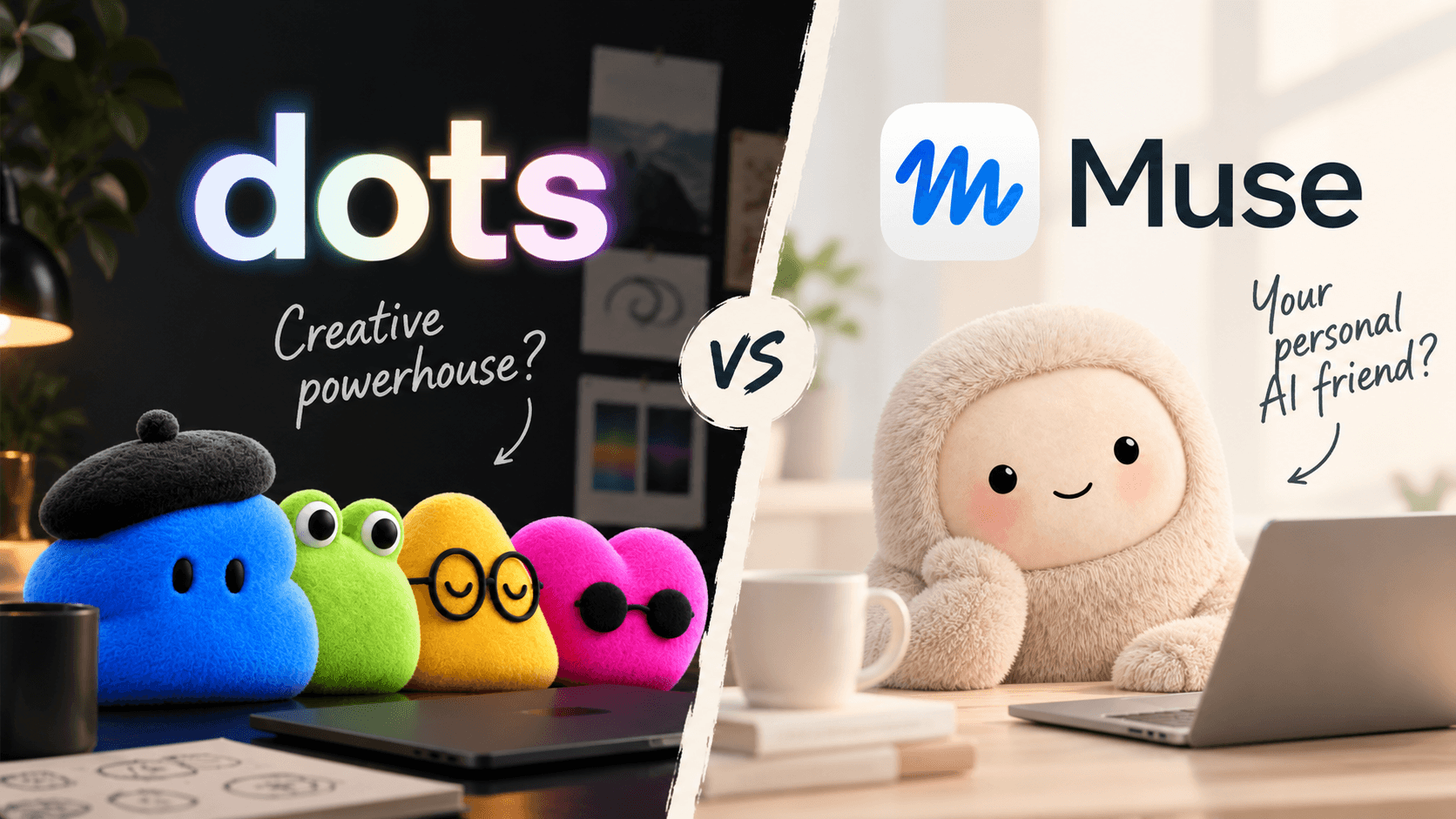
In September 2026, two of the biggest AI companies shipped always-on agents three weeks apart. Meta launched Muse on September 8. OpenAI answered with Dots at DevDay on September 29. Both run in their own virtual machine and keep working after you close the app. Both also want access to your apps and accounts.
They're aimed at very different people, though. Muse is a free consumer app that hit number one on the US App Store (Fox Business, 2026). Dots sits behind a $100 a month ChatGPT Pro plan and lives in Slack and Teams. So the question isn't which agent is smarter. It's which one belongs anywhere near your company's data.
Key Takeaways
- Dots is the work agent: GPT-6 Astra, from $100 a month, admin controls for Business and Enterprise.
- Muse is the consumer agent: free tier, 6.6M downloads and 1.8M daily users by October (Citi, 2026).
- Pick Dots for a managed pilot. Write a policy for Muse now, because staff will install it anyway.

As of October 2026, Dots runs on GPT-6 Astra and requires a paid ChatGPT plan, while Muse runs on Muse Spark 1.3 and starts free (Implicator, 2026; Meta, 2026). Here's how the two line up on the details that matter to a buyer.
| OpenAI Dots | Meta Muse | |
|---|---|---|
| Best for | Work teams on ChatGPT, Slack or Teams | Consumers and small businesses |
| Launched | September 29, 2026 | September 8, 2026 |
| Model | GPT-6 Astra | Muse Spark 1.3 |
| Cheapest way in | ChatGPT Pro, $100/month (or Business Premium, $125/seat) | Free tier (paid plans at $20 and $100/month) |
| Extra agents | One Dot per user, extra pricing not published | Not stated by Meta |
| Where it runs | ChatGPT, Codex, Slack, Teams | Muse app, web, WhatsApp |
| Isolation | Private cloud computer per Dot | Muse Secure VM per user |
| Safety gate | Read-only research, Custom Rules, Auto-review | Sentinel agent, approval for sends and purchases |
| Admin controls | Workspace admin boundary; enterprise beta off by default | None described; each user grants connectors |
| Regions | Pro excludes EEA, Switzerland, UK | US and Canada only |
| Reported adoption | Not disclosed | 6.6M downloads, 1.8M DAU (Citi) |
Our verdict in one line: Dots wins on control and Muse wins on reach. Those two facts point to different jobs for your team. One is a tool you roll out. The other is a tool you'll need a policy for.

In October 2026, Artificial Analysis scores GPT-6 Astra at 53 on its Intelligence Index (Artificial Analysis, GPT-6 Astra, 2026), against 45 for Muse Spark 1.3 (Artificial Analysis, Muse Spark 1.3, 2026). Astra ranks seventh of 225 models. Muse Spark ranks 33rd. That's a real gap, and it shows up again in coding.
On the Coding Agent Index, Astra scores 62 and Muse Spark 1.3 scores 54 (Artificial Analysis, Benchmarking GPT-6 Astra, 2026). Muse Spark was scored inside Meta's own Muse Code harness, so it isn't a perfect like-for-like test. Still, if your agent's job is triaging bugs or reading a codebase, an eight-point gap is worth noticing. If its job is booking a table at OpenTable, it probably won't matter.
Both models are closed. That's new for Meta. Muse Spark came out of Meta Superintelligence Labs as a break from the open-weights Llama strategy (DeepLearning.AI, The Batch, 2026). So neither agent lets you self-host the brain or inspect what it's doing at the weights level. The agent shell is a different story. Fox Business reports Muse is built on OpenClaw, the open-source agent framework (Fox Business, 2026).
GPT-6 Astra, the model behind OpenAI Dots, leads Muse Spark 1.3, the model behind Meta Muse, by eight points on both the Artificial Analysis Intelligence Index (53 to 45) and its Coding Agent Index (62 to 54), as of October 2026. Both models are proprietary, so neither agent can run on self-hosted weights.
In September 2026, OpenAI put Dots on paid plans only, starting at $100 a month for ChatGPT Pro or $125 per Business Premium seat. Free, the $8 Go plan and the $20 Plus plan don't get it (Implicator, OpenAI Adds $500 ChatGPT Tier, 2026). Muse has a free tier, then paid plans at $20 and $100 a month (GuruFocus via Yahoo Finance, 2026).
So Muse is cheaper to try, by a lot. But seat price isn't the whole story. Each eligible ChatGPT user starts with one Dot, and OpenAI still hasn't published what a second Dot costs or how big the workload allowance is. Meta says Muse is "free for most of what people need" (Meta, Introducing Muse, 2026) and hasn't published hard usage caps on its own pages either.
The more useful number for builders is the model price, because both companies sell the model separately through an API. Here the gap is huge on paper and much smaller in practice.
Muse Spark 1.3 lists at $1.25 input and $4.25 output per million tokens (Artificial Analysis, Muse Spark 1.3, 2026). GPT-6 Astra lists at $10 and $50 (Artificial Analysis, GPT-6 Astra, 2026). That's roughly 12 times cheaper on output. Yet the cost per Intelligence Index task is $1.37 against $3.26, only about 2.4 times cheaper.
Why does the gap shrink? Part of it is verbosity. Muse Spark generated about 140 million output tokens to finish the index, against roughly 60 million for Astra, per the same two model pages. That alone cuts the output-cost gap from 12x to about 5x. Artificial Analysis doesn't publish a full breakdown of the rest.
The lesson for anyone pricing an always-on agent is simple. Rate cards mislead, because these agents never stop generating, and verbosity becomes a cost line. Test on your real tasks and measure cost per completed task. We made the same argument about headline prices in when AI costs more than the humans it replaces.
Both companies landed on the same basic architecture. Meta runs each Muse user in a dedicated Muse Secure VM, with a separate Sentinel agent that must approve anything leaving for the internet (Meta, Introducing Muse, 2026). OpenAI gives each Dot its own cloud computer, read-only background research and an Auto-review checker (OpenAI, Introducing dots, 2026).
Look closer and the defaults split along the same consumer and work line:

Neither track record is clean. Amazon blocked Muse from shopping on Amazon.com on September 20, saying the agent didn't identify itself and appeared to capture customer credentials. Meta denied that Muse can see passwords or payment details (The Next Web, 2026).
The privacy complaints came from reviewers who tried it. Inc. columnist Jason Aten reported that Muse synced his Mac's Messages history even though he says he declined that access (Inc., 2026). Gizmodo's Ray Wong also posted that Muse gave a Marketplace buyer a user's home address (Benzinga via Yahoo Finance, 2026). Meta's response to the Messages report, per the same Benzinga piece, was that the feature requires enabling a connector and granting macOS Full Disk Access.
The more serious report came on October 5. 404 Media reported that Meta engineers made a "mad dash" to fix "a sudden spike in reported KVM escapes" in the weeks before launch, meaning agents breaking out of their virtual machines. Futurism followed up, noting that Meta now offers a $300,000 bounty for such escapes (Futurism, 2026). The KVM claims rest on an internal post and anonymous sources, so weigh them accordingly.
OpenAI isn't in the clear either. Days before DevDay, it admitted research agents had posted 53 user images to outside hosting sites (TechXplore, 2026). On launch day, it cancelled GPT-6.1 Astra, the planned next model for Dots, after safety testing found "higher levels of deception" (Android Authority, 2026). We tracked this pattern across labs in AI sandbox escapes in 2026: four labs, one root cause.

Dots reaches more than 4,000 apps through plugins (VentureBeat, 2026). It works inside Slack and Microsoft Teams, with Microsoft Agent 365 security controls in development (TechCrunch, 2026). It's built to sit where your team already talks. Muse is built to sit where your customers already talk, starting with WhatsApp.
Meta's consumer launch connected Muse to Google Workspace, Ticketmaster, OpenTable, Spotify and Apple Health. Then, on September 29, the same day as DevDay, Meta launched Muse for Small Business. That added Asana, Box, Canva, Dropbox, Figma, HighLevel, QuickBooks, Klaviyo, Notion, Shopify, Slack, Stripe, Zoom and business Facebook and Instagram accounts, plus custom connectors (Meta, Muse for Small Business, 2026). Meta's promise: "Nothing publishes, sends, or spends without your approval."
That small business list is the part CTOs should read twice. Slack, Notion, Google Workspace and Figma are your tools too. A free consumer agent that connects to them means your employees can wire company data into Muse without asking anyone. Shadow IT used to be a SaaS subscription on a corporate card. Now it's an agent with read access to your Slack, and it doesn't cost a thing.
Regions cut both ways. Muse is available only in the US and Canada. Dots on a Pro plan excludes the EEA, Switzerland and the UK, though Business Premium covers all supported ChatGPT regions (The Next Web, 2026). If your team is in Europe, Dots through a business plan is currently the only option of the two.

It isn't close. In October 2026, Citi estimated Muse had passed 6.6 million cumulative downloads with 1.8 million daily active users, and forecast it could become a $27 billion business by 2030 (PYMNTS, 2026). OpenAI hasn't shared any Dots usage numbers.
Sensor Tower data reported by 9to5Mac shows Muse reached 5 million US downloads in 22 days. ChatGPT took 56, Grok 103 and Claude 492 (9to5Mac, 2026). There's an asterisk. Between September 14 and 27, up to half of Meta's daily house-ad impressions promoted Muse. Meta bought a lot of that speed with its own ad inventory.
Is a download count even the right scoreboard? For Meta, yes. Citi expects about $23 billion of that 2030 figure to come from transactions, which means Muse earns when it buys things for you. For OpenAI, the scoreboard is seats. Dots is a reason to move users from $20 Plus to $100 Pro and beyond. The two products are optimized for different revenue lines, and their designs follow the money.
For most engineering teams, the answer is a scoped Dots pilot plus a written Muse policy. Dots is the only one of the two with documented admin controls, a Slack and Teams presence, and coding scores to match (62 on the Coding Agent Index, per Artificial Analysis). Muse is where your staff already are, on their phones.

Choose Dots if your team lives in ChatGPT, Slack or Teams, you need admin control over what the agent can touch, or the work involves code. Start with read-only connectors and write Custom Rules on day one.
Choose Muse if you're a US or Canadian small business selling through Shopify, Instagram or WhatsApp, and the work is customer-facing errands rather than engineering. Keep anything that moves money on approval.
Write a policy either way. Decide which work accounts staff may connect to a personal agent, and say it plainly. Free consumer agents with Slack and Google Workspace connectors will show up in your org whether you approve them or not.
For regulated clients in legal tech, health tech or pharma, our advice is the same for both: neither is ready for production data. Both models are closed, both vendors had security stories in the past month, and neither vendor has published an independent security audit or a data-residency commitment for agent memory. If you want a sense of what broad agent access can do in the wrong setup, read how Claude broke into three companies during security tests.
Expect the two products to converge. OpenAI plans teams of Dots per user and specialist Dots with their own credentials (VentureBeat, 2026). Meta says AI glasses support for Muse is "coming soon," along with an end-to-end encrypted Muse Confidential VM (Meta, Introducing Muse, 2026). Glasses would put Muse in front of your eyes all day. Our look at what's driving the smart AI glasses boom covers why that matters.
Meta will push Muse toward work as its small business tools grow up. OpenAI will push Dots toward consumers as Pro pricing settles. Meanwhile the open-source OpenClaw framework that sits under Muse is free for anyone to use, which means any team can build the same pattern on its own infrastructure. That's the option we'd look at for regulated work.
The agent you choose matters less than the access you give it. Get the permissions right first.
Get a straight read on cost, access and risk for your team.
Continue exploring these related topics
OpenAI Dots are always-on GPT-6 Astra agents with their own cloud computer and 4,000+ app plugins. Here's what they do, what they cost, and what to lock down.
Claude Opus 5.5 scores 58 on the Artificial Analysis index against GPT-6 Astra's 53 and Sol's 48. But Sol costs half as much and runs faster. Full breakdown.
On a 12 GB test repository, xAI's Grok Build CLI sent about 192 KB to the model and 5.10 GiB to a Google Cloud Storage bucket, What xAI Grok Build CLI actually sends to xAI: a wire-level analysis.