
LLMs
Agentic AI
Gemini 4 Argon Review: Benchmarks, Price and Verdict (2026)
Gemini 4 Argon tops the Vals Index at 68.9% but trails Claude Opus 5.5 on terminal coding, and its $2/$10 price doubles on Dec 1. See who should switch now.
•12 min read
Discover NVIDIA Nemotron 3 Nano—an open MoE LLM with up to 1M-token context, built for fast tool-using AI agents, RAG, and long workflows. 🚀.
If you’ve ever shipped an LLM feature, you know the lifecycle:
On Dec 15, 2025, NVIDIA dropped Nemotron 3 (sizes: Nano, Super, Ultra) an open model family built for the agent era: long-context, tool-using, multi-step workflows that don’t faceplant halfway through a task.
NVIDIA’s premise is simple:
Modern AI isn’t “one prompt → one answer.”
It’s many steps, many tools, many tokens.
Nemotron 3 is designed to keep agents:
And yes, NVIDIA says Nemotron 3 Nano is ~4× higher token throughput than Nemotron 2 Nano, and can reduce reasoning-token generation by up to 60%
Nemotron 3 Nano is available immediately; Super and Ultra are planned for the first half of 2026.
Here’s where the spicy stats start 🌶️📊:
Up to 1,000,000-token context window (yes, 1M)
MoE model: 31.6B total parameters
Pretrained on 25 trillion text tokens (including 3T+ new unique tokens over Nemotron 2)
Translation for humans: big brain available, small brain bill 🧾😅
Because a lot of agent pain comes from chunking gymnastics:
With a native 1M-token window, Nemotron 3 is explicitly targeting:
NVIDIA’s own technical blog frames this as enabling sustained reasoning across long-horizon, multi-agent workflows.
In NVIDIA’s technical report, Nemotron 3 Nano reports:
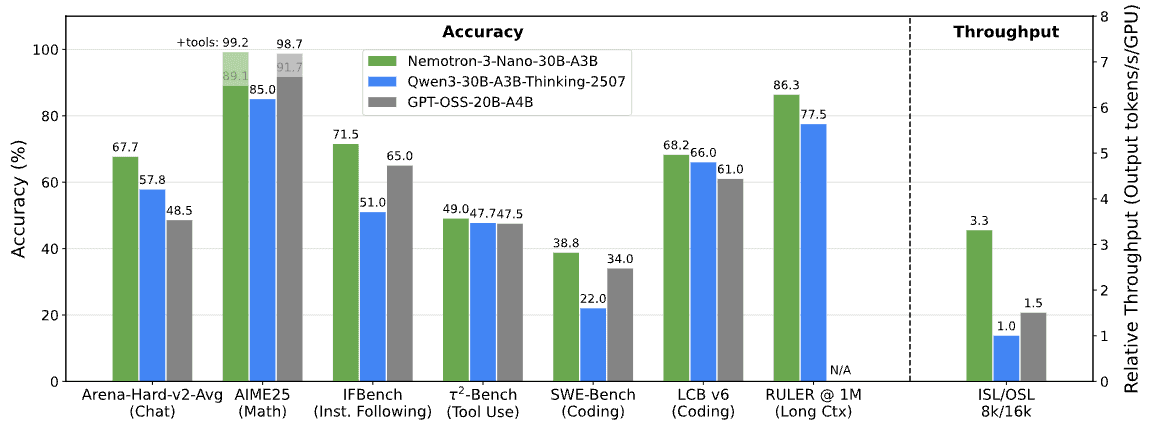
Up to 3.3× higher inference throughput vs similarly sized open models in their comparisons
On an 8K input / 16K output scenario: 2.2× faster than GPT-OSS-20B and 3.3× faster than Qwen3-30B-A3B-Thinking-2507 (in their tests)
That matters because agents don’t “answer once.” They loop:
plan → tool → read → verify → revise → repeat 🔁
So throughput isn’t a nice-to-have—it’s survival. 😅
NVIDIA describes:
Nemotron 3 Super: ~100B parameters, up to 10B active per token
Nemotron 3 Ultra: ~500B parameters, up to 50B active per token
And NVIDIA’s technical blog says Super/Ultra will add enhancements like:
NVIDIA is leaning into openness beyond “here’s weights, good luck”:
Nano report says they provide recipe, code, and most of the data used to train it
NVIDIA’s technical blog mentions a nearly 10 trillion token synthetic pretraining corpus that can be inspected/repurposed
If you want to feel Nemotron 3’s intent, don’t ask for a poem.
Try:
If it stays coherent over long context and doesn’t hallucinate tool calls like it’s improvising jazz 🎷… you’re in business.
Nemotron 3 is NVIDIA saying:
“We’re not just powering the models. We’re shipping open models designed for real agent workloads.”
And the stats back the direction: 1M context, MoE efficiency (31.6B total / ~3.2B active), and major throughput claims tuned for multi-agent systems.
We can explore how Nemotron 3 Nano applies to your unique AI challenges.
Continue exploring these related topics
Gemini 4 Argon tops the Vals Index at 68.9% but trails Claude Opus 5.5 on terminal coding, and its $2/$10 price doubles on Dec 1. See who should switch now.

Claude Opus 5.5 scores 58 on the Artificial Analysis index against GPT-6 Astra's 53 and Sol's 48. But Sol costs half as much and runs faster. Full breakdown.
GPT-6 Astra scores 72.6% on OSWorld 2.0 and costs $10/$50 per million tokens. Here's what OpenAI's AGI-era model actually changes, and what it doesn't.