
Working on this in your product? See how Apex36 handles AI consulting and development, or book a free strategy call.
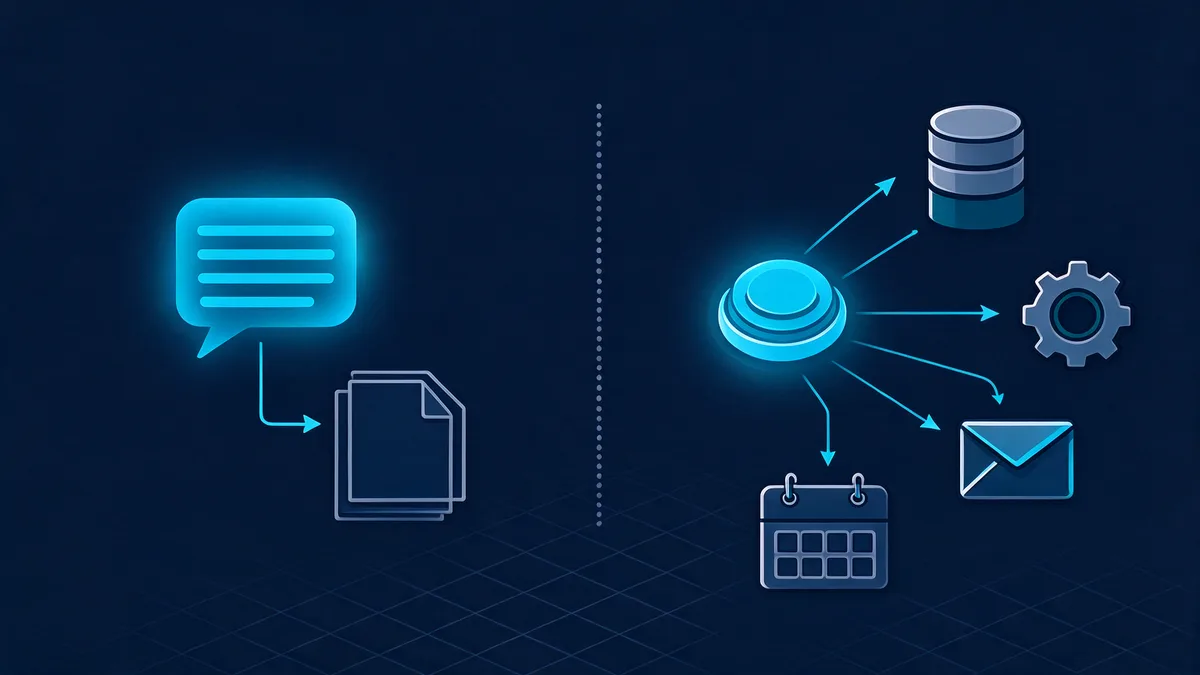
The difference between an AI agent and a chatbot is simple: a chatbot answers questions, and an AI agent takes actions across your tools to finish a task. Many products do a bit of both. The harder question is which one your problem needs, and the honest answer is often "less agent than the sales pitch suggests". This guide explains the difference, what each costs to run, and how to choose.
The short answer
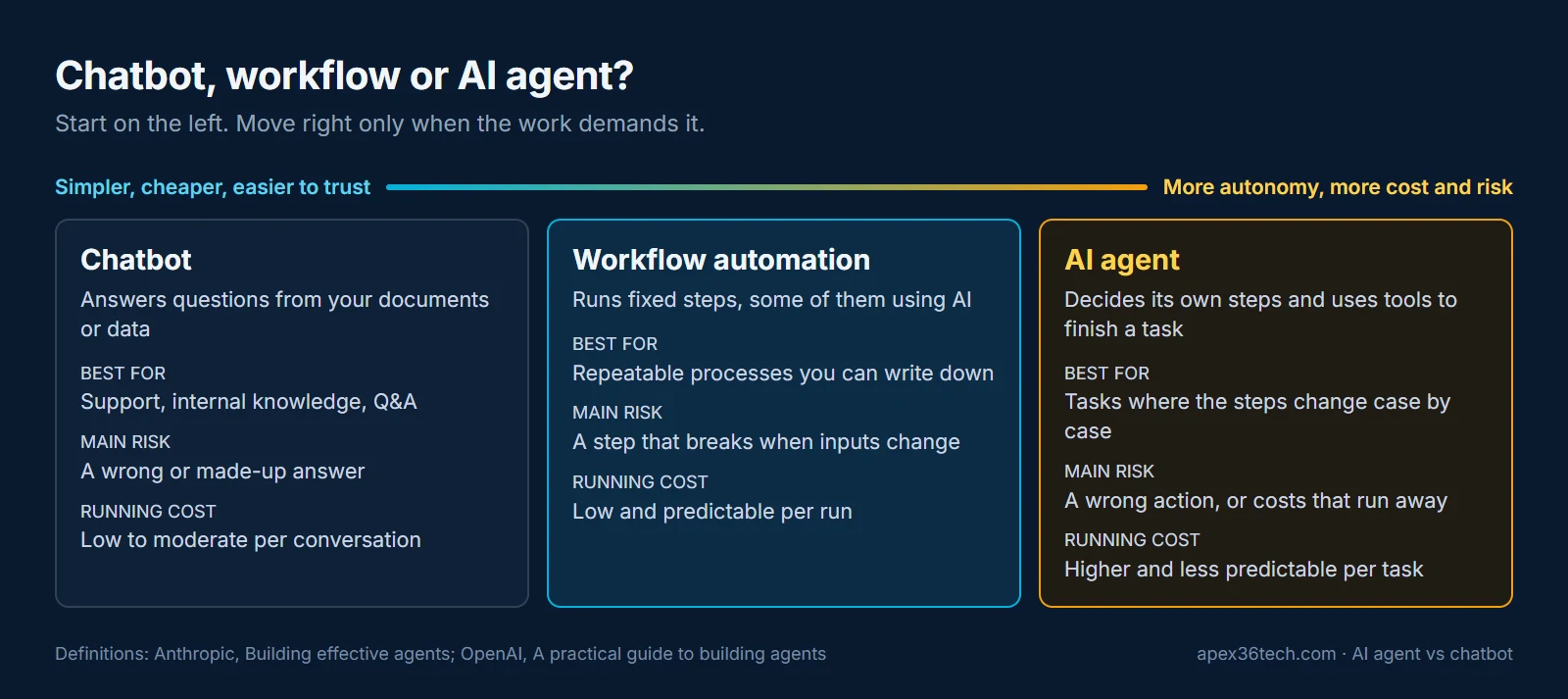
| Chatbot | Workflow automation | AI agent | |
|---|---|---|---|
| What it does | Answers questions from your documents or data | Runs fixed steps, some of them using AI | Decides its own steps and uses tools to finish a task |
| Best for | Support, internal knowledge, Q&A over data | Repeatable processes you can write down | Tasks where the steps change case by case |
| Main risk | A wrong or made-up answer | A step that breaks when inputs change | A wrong action, or costs that run away |
| Running cost | Low to moderate per conversation | Low and predictable per run | Higher and less predictable per task |
Most businesses should start in the left or middle column and move right only when the work demands it.
How the model makers define it
The companies that build these models draw the line clearly.
- Anthropic separates two kinds of systems: "Workflows are systems where LLMs and tools are orchestrated through predefined code paths. Agents, on the other hand, are systems where LLMs dynamically direct their own processes and tool usage, maintaining control over how they accomplish tasks."
- OpenAI's guide to building agents says: "Agents are systems that independently accomplish tasks on your behalf." It adds that apps which use a language model but don't let it control how the work runs, such as simple chatbots, are not agents.
- What an agent is made of: OpenAI lists three parts: a model, tools, and instructions.
Both give the same advice. Anthropic recommends "finding the simplest solution possible, and only increasing complexity when needed. This might mean not building agentic systems at all."
When a chatbot is enough
If the job ends in an answer, you need a chatbot, sometimes called an AI assistant. A good one answers only from approved sources, shows where each answer came from, and says when it doesn't know.
Examples from our own builds:
- Legal research: an assistant for DecoverAI that answers questions from large sets of case documents.
- Regional law: a legal assistant that answers questions from UAE laws and documents, for that jurisdiction only.
- Executive analytics: an in-app assistant that answers executives' questions about complex time-series data in plain language, so they don't have to work the charts themselves.
None of these needs to take actions. Each needs accurate retrieval, citations and a clear "I don't know".
When you need an AI agent
OpenAI's guide lists three signs a task suits an agent:
- Complex decisions that need judgement, not a checklist.
- Rules that are hard to maintain because there are too many exceptions.
- Heavy use of unstructured data, such as emails, documents or free text.
If your task doesn't clearly meet these, the guide says, "a deterministic solution may suffice."
Two examples from our work:
- Multi-agent coding: for BlackBox AI, several coding agents attempt the same task in parallel, each on its own branch, and a judge model picks the best result. The steps differ every time, so a fixed workflow can't do it.
- Requirements to tickets: Mappie AI turns vague requirements into epics, requirements and user stories, step by step, inside the product manager's editor.
When you need neither: plain automation
Some AI projects are really automation projects. If you can write the steps down and they rarely change, a workflow is cheaper, faster and easier to trust than an agent.
Our drug-safety literature screening pilot is a good example. A small model triages each article, a larger model reviews it, and every decision is logged. By Anthropic's definition that's a workflow with AI steps, not a free-running agent, and that's deliberate: a pharmacovigilance team needs every result to be traceable.
Gartner makes the same point. In June 2025 it said "many use cases positioned as agentic today don't require agentic implementations" and predicted that over 40% of agentic AI projects will be cancelled by the end of 2027 "due to escalating costs, unclear business value or inadequate risk controls." Its advice: use agents when decisions are needed, automation for routine workflows and assistants for simple retrieval.
What each one costs to run
Build cost depends on scope. Running cost depends on how many model calls each task makes.
- Chatbots usually make one or a few model calls per question, so cost per conversation stays low. Off-the-shelf support bots now often charge per result. Intercom's Fin charges $0.99 per outcome on a $49 a month base plan that includes 50 resolutions. One detail to read closely: a conversation counts as resolved if the customer simply leaves without asking for more help.
- Agents may call the model dozens of times per task and use several tools along the way, so cost per task is higher and varies more. Always set a spend cap per task and per month.
- Workflows cost the least per run because the number of steps is fixed.
At Apex36, a first chatbot or a first agent with one or two tools starts from $8,000, with a fixed quote after discovery. See our AI chatbot development and AI agent development pages for what's included.
Five questions to ask before you choose
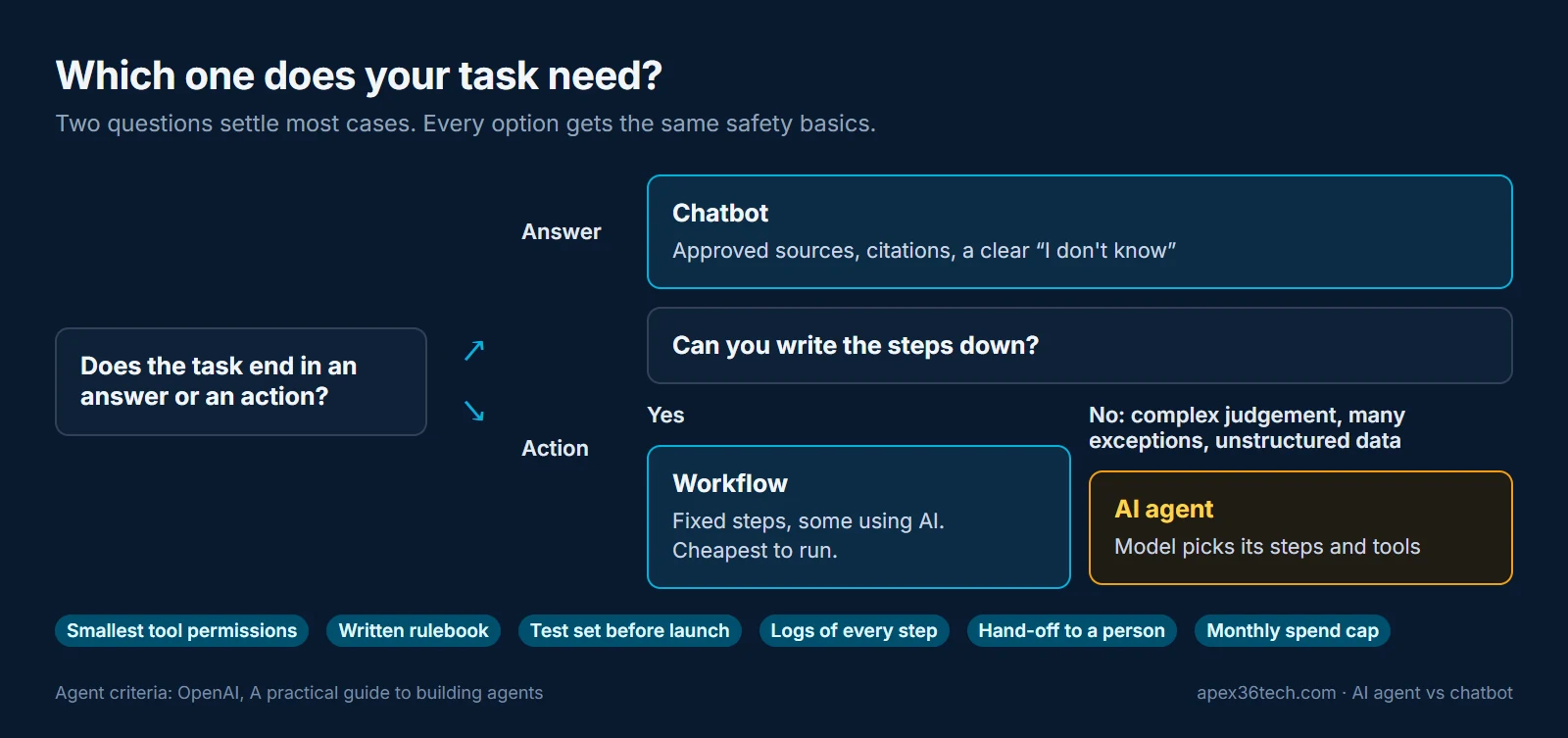
- Does the task end in an answer or an action? Answer: chatbot. Action: workflow or agent.
- Can you write the steps down? If yes, start with a workflow.
- What happens when it's wrong? The higher the cost of a mistake, the more you need logs, limits and a person in the loop.
- How will you test it? Collect 30 to 50 real examples with known right answers before you build.
- Who owns it after launch? Make sure the code, prompts and test set live in your repository, so you can change it without the vendor.
How we build either one
Whether it's a chatbot or an agent, we use the same safety basics:
- Tools with the smallest permissions that work
- A written rulebook the system follows
- A test set it must pass before launch
- Logs of every step and answer
- A hand-off to a person when it isn't sure
- A monthly spend cap
FAQ
What is the difference between an AI agent and a chatbot?
A chatbot answers questions, usually from your documents or data. An AI agent decides what steps to take and uses tools, such as your CRM, inbox or database, to finish a task. Many products combine both.
Is ChatGPT a chatbot or an AI agent?
Both, depending on how you use it. Answering a question is chatbot work. When it browses, runs code or completes tasks across several steps on its own, it's acting as an agent.
Are AI agents better than chatbots?
No, just different. Agents cost more to run and are harder to test. If your task ends in an answer, a well-built chatbot is the better choice.
How much does an AI agent cost?
At Apex36, a first agent with one or two tools and a test set starts from $8,000. Running costs depend on how many model calls each task makes, so we set a spend cap from day one.
Can a chatbot become an agent later?
Yes. Many teams start with a chatbot that answers questions, then add one action at a time, such as creating a ticket or updating a record, once the answers are reliable.
Not sure if you need an agent?
Tell us the task and we'll say which approach fits, and why.